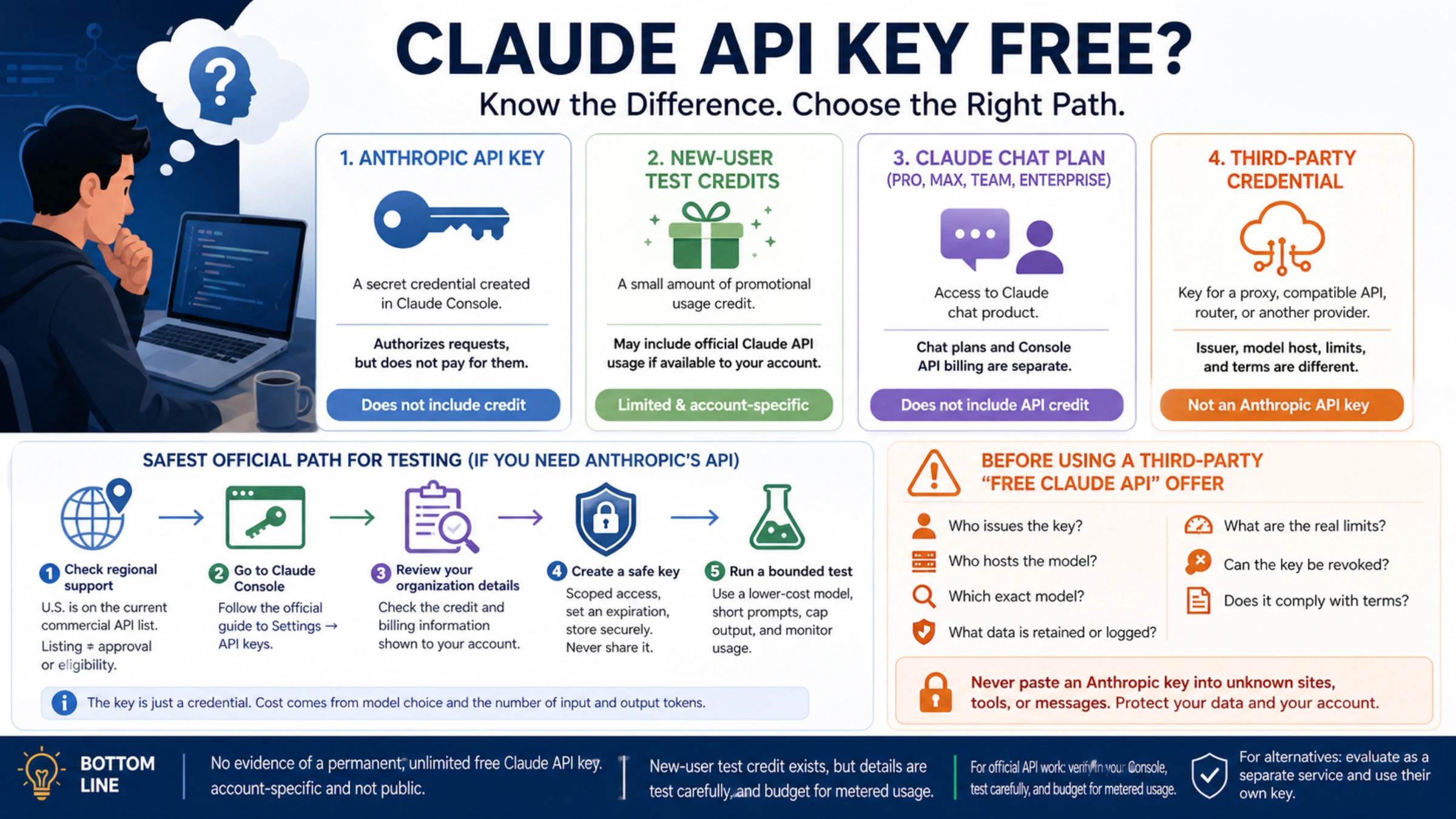
Short answer: Anthropic says new users receive a small amount of free credits to test the Claude API, but it does not document a permanent free API tier. The public pricing page does not specify the credit amount, expiration, whether every account receives it automatically, or whether a payment method is required. After any available credit is used, normal Claude API usage is metered and usually funded with prepaid usage credits.
Creating an API key and paying for API calls are separate steps. A key is only a credential; it is not a balance, subscription, or promise of free usage.
If your project must call Anthropic-hosted Claude models, use the official Claude Console and check the offer shown for your own organization. If your project only needs a low-cost model behind a Claude Code workflow or a Claude-compatible endpoint, a third-party provider may be an option—but that provider's key is not an Anthropic API key.
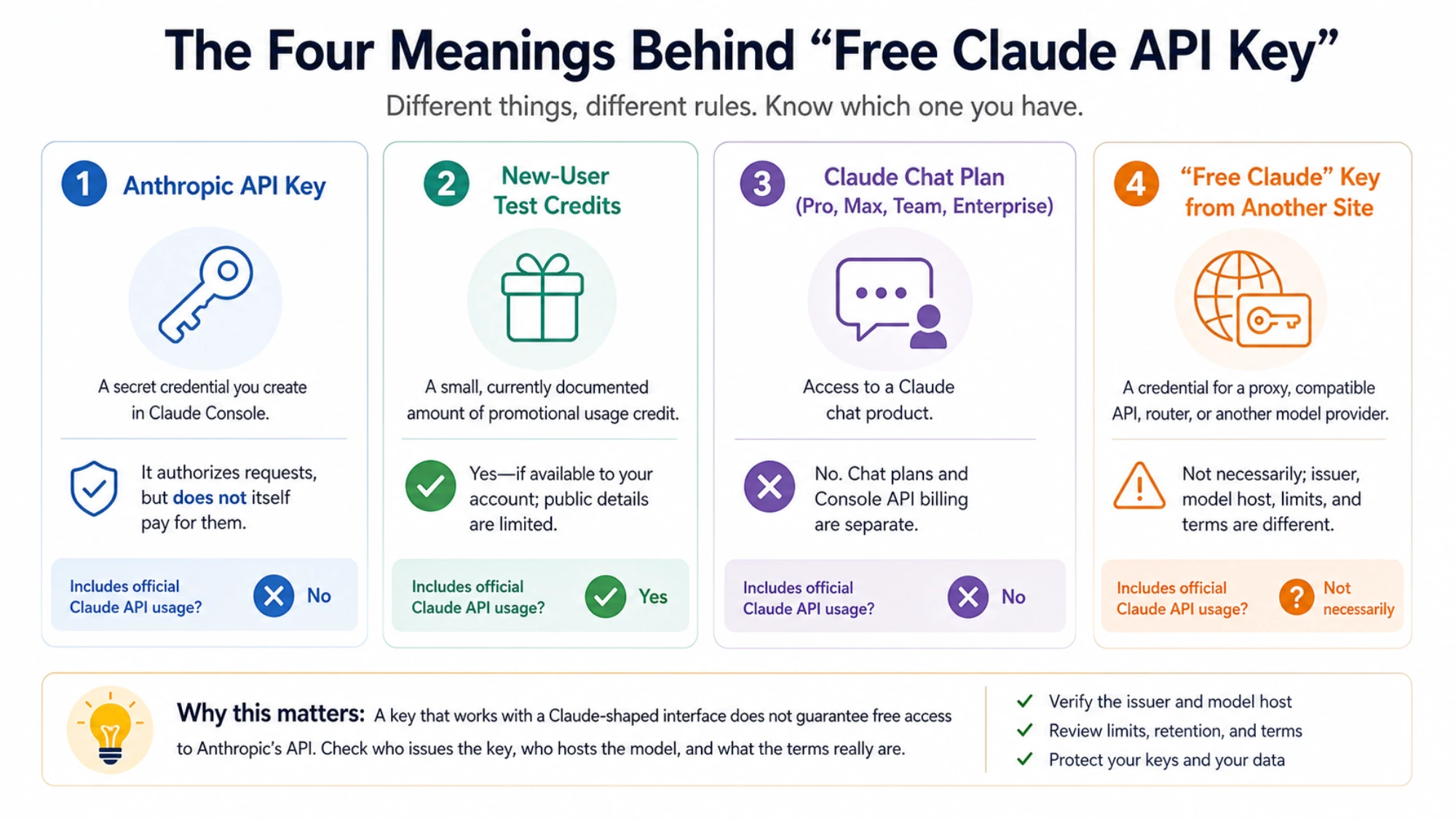
The four things that “free Claude API key” can mean
| What you may be looking for | What it actually is | Does it include official Claude API usage? |
|---|---|---|
| An Anthropic API key | A secret credential created in Claude Console | It authorizes requests, but does not itself pay for them |
| New-user test credits | A small, currently documented amount of promotional usage credit | Yes, if available to your account; public details are limited |
| A Claude Pro, Max, Team, or Enterprise chat plan | Access to a Claude chat product | No. Chat plans and Console API billing are separate |
| A “free Claude” key from another site | A credential for a proxy, compatible API, router, or another model provider | Not necessarily; issuer, model host, limits, and terms are different |
That distinction prevents the most common mistake: finding a key that works with a Claude-shaped interface and assuming it grants free access to Anthropic's API.
What Anthropic currently says about free access
As of August 25, 2026, Anthropic's official pricing page says new users receive a small amount of free credits to test the API. It does not publicly state:
- the exact amount;
- how long the credits last;
- whether the grant is automatic for every new account;
- the complete eligibility rules; or
- whether a payment method is required before creating a key or using the credit.
Treat any more specific number found in a search result, forum post, or AI summary as unverified unless the current Claude Console or an Anthropic page confirms it for your account.
For regular usage, Anthropic explains that most Console organizations buy prepaid usage credits. Successful API calls and playground use consume the balance, and access stops when it runs out. Purchased credits expire one year after purchase and are non-refundable. Organizations with a Sales-arranged invoicing agreement can follow a different billing route.
Anthropic also publishes positive input and output token prices for its API models. Because models and rates can change, use the live pricing page for an estimate instead of relying on an old cost table.
A paid Claude plan does not include API credit
Paying for Claude Pro, Max, Team, or Enterprise chat access does not fund ordinary Console API calls. Anthropic's billing explanation treats Claude subscriptions and the Claude Console as separate products.
This matters if you already pay for Claude and expect that subscription to expose an API key. For an application that sends API requests, check Console access and API billing separately.
The safest official path for testing
Use this route when your requirement is specifically “my application must call Anthropic's Claude API.”
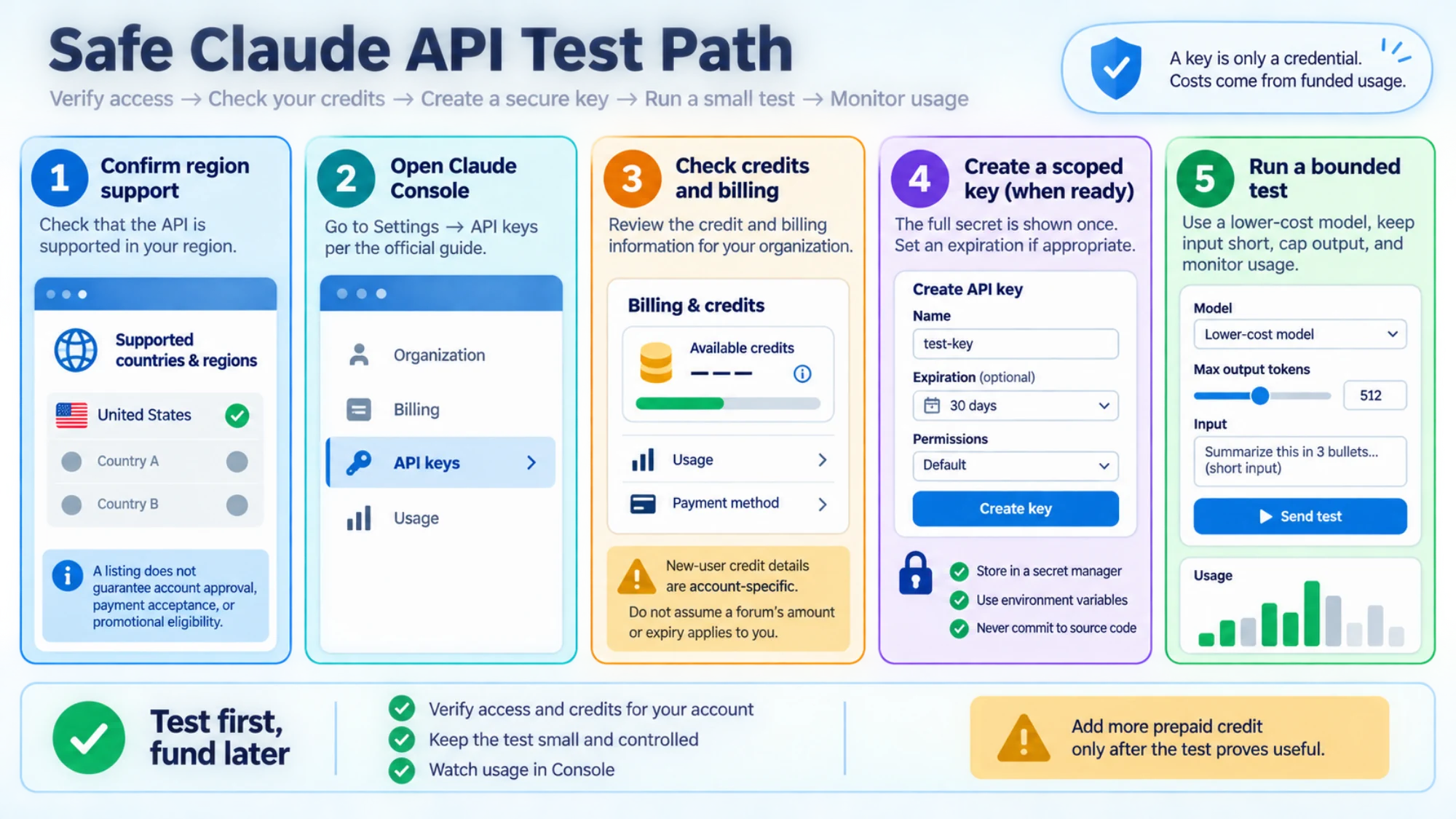
- Confirm that the API is supported in your region. Anthropic currently lists the United States among its supported countries and regions. A country listing does not guarantee account approval, payment acceptance, or promotional eligibility.
- Open the official Claude Console. Follow Anthropic's API key guide, which points to Settings → API keys.
- Inspect the credit and billing information shown for your organization. The public documentation does not settle the account-specific details of the new-user credit. Do not assume a forum's amount or expiry applies to you.
- Create a narrowly scoped key only when you are ready to use it. The full secret is shown once. Give it an expiration when appropriate and store it in a secret manager or environment variable, never in source code or a public repository.
- Start with a bounded test. Choose a lower-cost model that meets your task, keep the input short, cap the response length, and monitor usage in Console. Add more prepaid credit only after the test proves useful.
The key itself may be easy to create; the meaningful cost control is the amount of funded usage, the model selected, and the number of input and output tokens consumed.
Before using a third-party “free Claude API” offer
Many free-looking results solve a different problem. They may configure Claude Code as a client while routing requests to another provider, expose a Claude-compatible endpoint, substitute another model, or grant temporary promotional credit issued by a third party.
That can still be useful when your real goal is “run a coding agent cheaply.” It is not equivalent when your requirement is “call an Anthropic-hosted Claude model through Anthropic's API.”
Before entering a credential or sending any prompt, answer these questions:
- Who issues the key? The domain and account should make this explicit.
- Who hosts the model? A compatible API format does not establish model identity.
- Which exact model processes the request? Do not infer this from the word “Claude” in a tool's name.
- What data is retained or logged? Check the privacy policy and data-processing terms, especially for source code or customer data.
- What are the real limits? Look for quotas, expiry, rate limits, geography, and whether payment begins automatically.
- Can the credential be revoked? Avoid services without clear key management and incident support.
- Does the integration comply with the client and provider terms? Independent routing projects can change as provider policies change.
Never paste an Anthropic key into an unrelated “key checker,” browser extension, public playground, shared configuration file, or chat message. A legitimate service should not need you to reveal an existing secret merely to prove that it works.
Choose the path that matches your actual requirement
You need Anthropic's official Claude API
Use Claude Console. Check the small new-user test credit displayed for your organization, if any, and plan for metered paid usage. This is the only path in this article that should be described as an official Anthropic API key.
You need a cheap proof of concept, but the provider can change
Compare reputable providers on model identity, price, retention, limits, and terms. Use that provider's own key and label the integration accurately in your code and documentation. Do not present a substitute model or proxy as the official Anthropic API.
You only want to try Claude as a person
Use Anthropic's consumer Claude product rather than building an API integration. Consumer chat access and developer API billing remain separate, so this will not give your application an API key.
You already pay for a Claude subscription
Keep using the subscription for its intended chat features, but create and fund a separate Console organization if your application requires API calls.
Common questions
Can I download a free Anthropic API key?
No legitimate source should distribute a reusable Anthropic secret for download. Create and manage your own key in Claude Console. Shared or published keys can be revoked, abused, or used to expose data and charges.
Does every new account receive the same free credit?
Anthropic currently documents a small amount of credits for new users, but the public page does not specify the amount, expiry, automatic-grant behavior, complete eligibility, or payment prerequisite. Check the information shown inside your own Console organization.
Is there an unlimited free Claude API key?
Anthropic's current official documentation does not establish an unlimited free API tier. Official API models have metered token prices, and ordinary Console usage generally consumes credits.
Can I use my Claude Pro or Max subscription as API credit?
No. Anthropic documents paid Claude chat plans and Claude Console API usage as separate products.
Is an OpenRouter or other provider key a Claude API key?
It is a key from that provider. The service may route to particular models or expose a compatible request format, but its billing, privacy terms, model availability, rate limits, and credentials are separate from Anthropic's Console.
Bottom line
There is no evidence here for a permanent, unlimited free Claude API key. There is current first-party evidence for a small amount of new-user test credit, but its account-specific details are not public. For official Claude API work, create the credential only in Claude Console, verify the credit and billing terms shown to your organization, and run a tightly bounded test. For any alternative, name the provider honestly and evaluate it as a separate service before sending code or sensitive data.