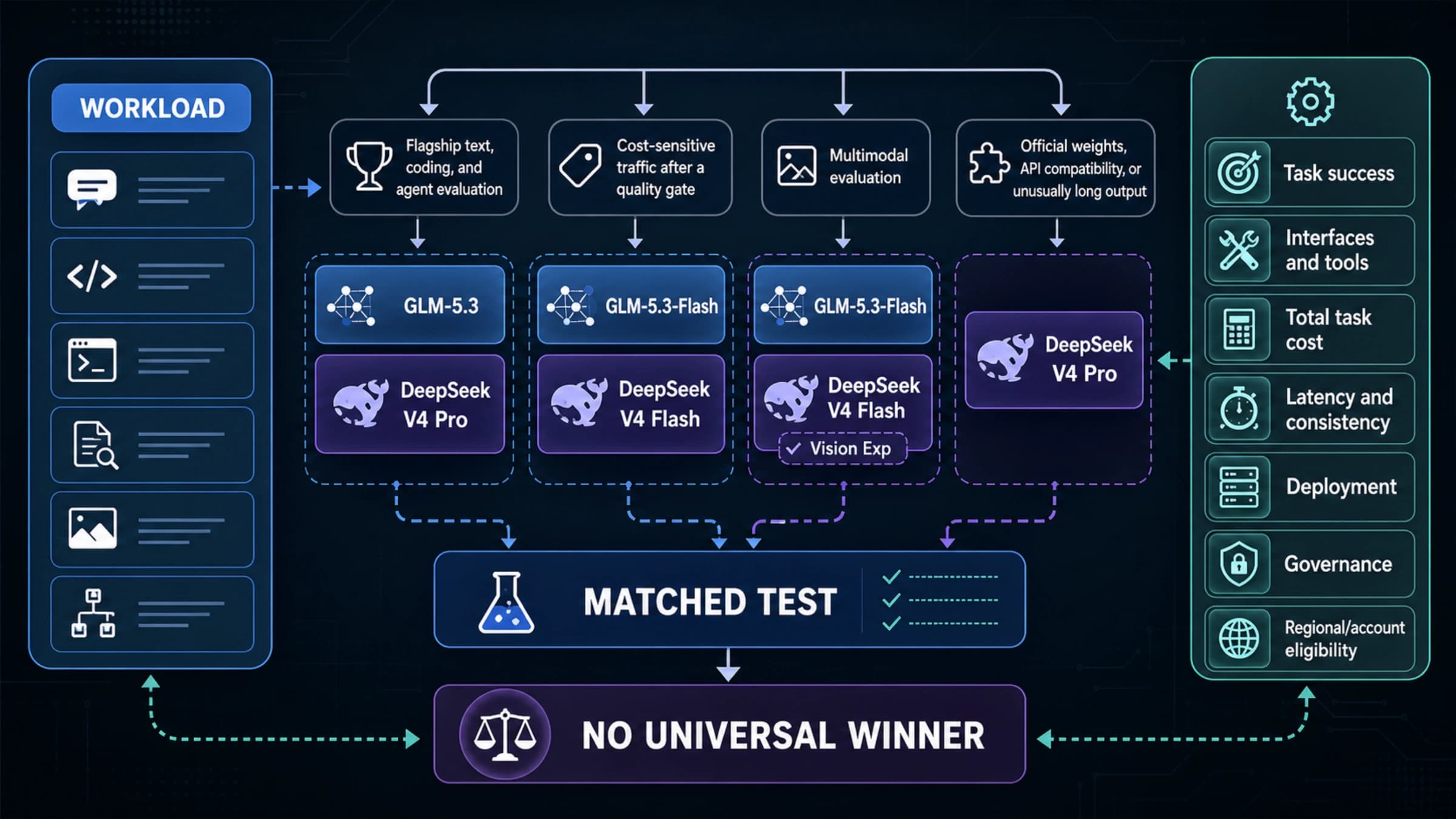
The short answer, based on public evidence checked August 13, 2026: test DeepSeek V4 Pro first when API cost or responsiveness is a hard constraint; test GPT-5.6 Sol first when documented image input or your existing OpenAI integration is non-negotiable. If accepted-output quality decides the purchase, run both through the same harness—the available evidence does not support a universal winner.
That conditional answer matters because the comparison is easy to get wrong. OpenAI’s unsuffixed gpt-5.6 API alias routes to GPT-5.6 Sol, not Luna or Terra, in the checked documentation. DeepSeek’s API identifier deepseek-v4-pro maps to DeepSeek-V4-Pro-0813. Tests involving GPT-5.6 Luna, GPT-5.6 Terra, or DeepSeek V4 Flash may be useful background, but they cannot decide this exact match-up.
The decision in one table
| Your gating requirement | First model to test | Why this is a first test, not a final winner |
|---|---|---|
| Lowest listed API token cost on August 13 | DeepSeek V4 Pro | Its checked list prices are much lower, but a change is scheduled for August 16 and cheap attempts do not guarantee cheap accepted work. |
| Image input | GPT-5.6 Sol | OpenAI explicitly documents text and image input for Sol; the DeepSeek API contract used here does not establish an equivalent capability. |
| First-token delay or output throughput is a product constraint | DeepSeek V4 Pro | One attributed configured comparison reports a large lead, but provider, region, load, and reasoning settings can change route-level behavior. |
| Highest task success rate | Test both | No independent current-pair, same-condition real-work evaluation was available on August 13, 2026. |
| A very large response ceiling | DeepSeek V4 Pro | The documented maximum output is 384K tokens versus 128K for Sol; verify practical limits, coherence, and cost with your own payloads. |
| Existing Responses API workflow | Either | Both official contracts support the Responses API, so integration shape alone does not settle the choice. |
| Self-hosted deployment | Separate evaluation | Hosted API measurements cannot be transferred to public weights without proof that the artifacts and serving stack behave equivalently. |
For most teams, the honest default is two-stage: screen for hard constraints first, then compare accepted outcomes. A missing required feature or a cost ceiling can eliminate a candidate. An aggregate benchmark gap usually cannot.
Confirm the exact pair before comparing
OpenAI’s GPT-5.6 Sol documentation describes Sol as the frontier GPT-5.6 model and says the gpt-5.6 alias points to it. The same page lists reasoning effort from none through max, a 1,050,000-token context window, a 128,000-token maximum output, text and image input, and text output.
DeepSeek’s August 13 update says V4 Pro reached general availability on the app, web, and API, while the API model name remains deepseek-v4-pro. Its current model table maps that identifier to DeepSeek-V4-Pro-0813 and lists a 1M-token context window, up to 384K output, thinking and non-thinking modes, tool calls, JSON output, the Responses API, and Anthropic-format API support.
Those names define the comparison boundary:
- Sol is not Luna or Terra. A Luna value test cannot prove Sol’s quality, latency, or cost.
- Pro is not Flash. A DeepSeek V4 Flash coding result cannot be promoted into a V4 Pro result.
- Reasoning effort is part of the model configuration. “Sol high” and “Pro max” are not automatically equivalent compute budgets.
- Hosted API and public weights are separate deployment claims. Do not use hosted API measurements as self-hosting forecasts unless the relevant artifact and serving conditions are verified.
This identity check is not trivia. Choosing the wrong tier can change the bill, available modalities, latency, and task success more than the family name suggests.
What the public evidence can—and cannot—settle
Use feature contracts as filters
Both models expose roughly one-million-token context windows and support tool-oriented API workflows. DeepSeek documents the larger maximum output: 384K tokens, compared with Sol’s 128K. Sol explicitly supports image input; the DeepSeek source used for this comparison does not establish matching image-input support.
These are selection facts, not quality scores. A million-token context limit does not show that either model retrieves the right detail from a million-token prompt. A larger maximum output does not show that a long generation will remain coherent. Tool-call support does not show that an agent completes a multi-step workflow correctly.
Treat the contract as a filter. If your workload requires an explicitly documented feature, remove models that fail the filter. Then test the survivors on the behavior that matters.
Compare dated list prices, not unlabeled token costs
On August 13, 2026, OpenAI lists GPT-5.6 Sol at $5 per million input tokens, $0.50 per million cached input tokens, and $30 per million output tokens. Requests above 272K input tokens are charged at 2× input and 1.5× output for the full request.
DeepSeek lists V4 Pro at $0.003625 per million cache-hit input tokens, $0.435 per million cache-miss input tokens, and $0.87 per million output tokens on the same checked date. DeepSeek also announces a scheduled change effective August 16, 2026 at 16:00 UTC:
| DeepSeek V4 Pro period | Cache-hit input / 1M | Cache-miss input / 1M | Output / 1M |
|---|---|---|---|
| Off-peak scheduled price | $0.022 | $0.66 | $1.98 |
| Peak scheduled price | $0.044 | $1.32 | $3.96 |
Peak windows are listed as 01:00–04:00 and 06:00–10:00 UTC. These future prices were not active on the checked date and should be revalidated after they take effect.
Consider a simplified request that uses 100,000 uncached input tokens and produces 10,000 output tokens, with no cache benefit. This stays below Sol’s documented 272K-input surcharge threshold:
- GPT-5.6 Sol list-price estimate:
0.1 × $5 + 0.01 × $30 = $0.80 - DeepSeek V4 Pro at the August 13 price:
0.1 × $0.435 + 0.01 × $0.87 = $0.0522 - DeepSeek V4 Pro at the scheduled peak price:
0.1 × $1.32 + 0.01 × $3.96 = $0.1716
The token-cost gap is real on these official price bases. It is still not a total-cost verdict. Retries, failed tool calls, longer outputs, validation, queueing, gateway markups, and human correction can dominate the price of an accepted result. Taxes, payment availability, quotas, data residency, and regional latency are also outside these global list-price facts.
Treat one exact-pair snapshot as a hypothesis
Artificial Analysis reports the following configured comparison for GPT-5.6 Sol at high effort and DeepSeek V4 Pro 0813 at max effort:
| Reported metric | GPT-5.6 Sol high | DeepSeek V4 Pro max |
|---|---|---|
| Intelligence Index | 57 | 53 |
| Blended price | $4.35 | $0.18 |
| Output speed | about 56 tokens/s | about 83 tokens/s |
| Time to first token | 19.28 s | 1.63 s |
This snapshot is valuable because it covers the exact model pair. It is not an apples-to-apples production trial. The effort labels differ, and the displayed blended price uses a 7:2:1 cache/input/output method rather than either vendor’s simple list-price columns. The aggregate Intelligence Index also cannot tell you which model completes your code migration, support workflow, extraction job, or visual analysis correctly.
Use the snapshot to form hypotheses: Sol’s higher reported index can justify a capability-first trial; DeepSeek’s reported latency, throughput, and blended-price figures can justify a cost-and-responsiveness trial. Do not turn four aggregate rows into “Sol wins quality” or “DeepSeek wins production.”
Choose the first trial by the failure you cannot tolerate
Give Sol the first run when capability constraints dominate
Sol deserves the first slot when the workload requires documented image input, when an OpenAI-specific model contract is a hard dependency, or when you are willing to pay more to investigate whether the higher attributed aggregate score transfers to your tasks.
That recommendation is intentionally narrow. OpenAI’s “frontier” positioning and a third-party index are reasons to test, not proof that Sol will deliver more accepted outcomes. Budget for the possibility that high input volume, long outputs, or retries make the evaluation expensive. If prompts exceed 272K input tokens, incorporate the documented long-context surcharge before approving a production estimate.
Give DeepSeek the first run when economics or responsiveness dominate
DeepSeek deserves the first slot when a low token-price ceiling is mandatory, when fast initial response and output throughput materially affect the product, or when its documented interface options reduce migration effort. The official current prices and the attributed latency snapshot both support a first look.
Again, the recommendation is bounded. The price schedule changes soon, provider-route latency varies, and there is no aligned exact-pair task-success study. A model that costs one-tenth as much per attempt but needs many retries—or produces results that fail final-state checks—may cost more per accepted task.
Test both immediately when quality is the gating variable
If a wrong answer, broken patch, failed transaction, or missed extraction is more expensive than the model bill, choosing from public aggregates is false precision. Put both models into the same controlled harness. This is not indecision; it is the shortest route to evidence that matches your product.
A practical acceptance test for the exact pair
A useful comparison keeps the workload constant and makes configuration differences visible rather than pretending the models are identical.
- Select 20–50 representative tasks. Include common cases, high-cost failures, long-context examples, and a small unseen holdout set. Use actual sanitized inputs where possible.
- Define acceptance before running. For code, require tests and static checks. For agents, verify final state in the target system. For extraction, compare required fields and critical errors. For multimodal tasks, test only a model whose documented input contract supports the media you send.
- Control what can be held constant. Use the same task inputs, system intent, tools, tool schemas, timeout policy, common output cap, and retry rules. Record provider adapters and any unavoidable API differences instead of hiding them.
- Expose reasoning settings. Choose settings that reflect the intended production budget. Do not label Sol
highand DeepSeekmaxas equivalent; report them as distinct configurations. - Repeat stochastic tasks. Run at least three trials where variance matters. A single successful demo is not a rate.
- Capture the full task bill. Log uncached input, cached input, output, retries, wall time, tool failures, validation failures, and human repair time.
- Review failures, not just averages. A similar mean score can hide different catastrophic failure modes. Decide whether a failure is recoverable by retry, validation, routing, or not at all.
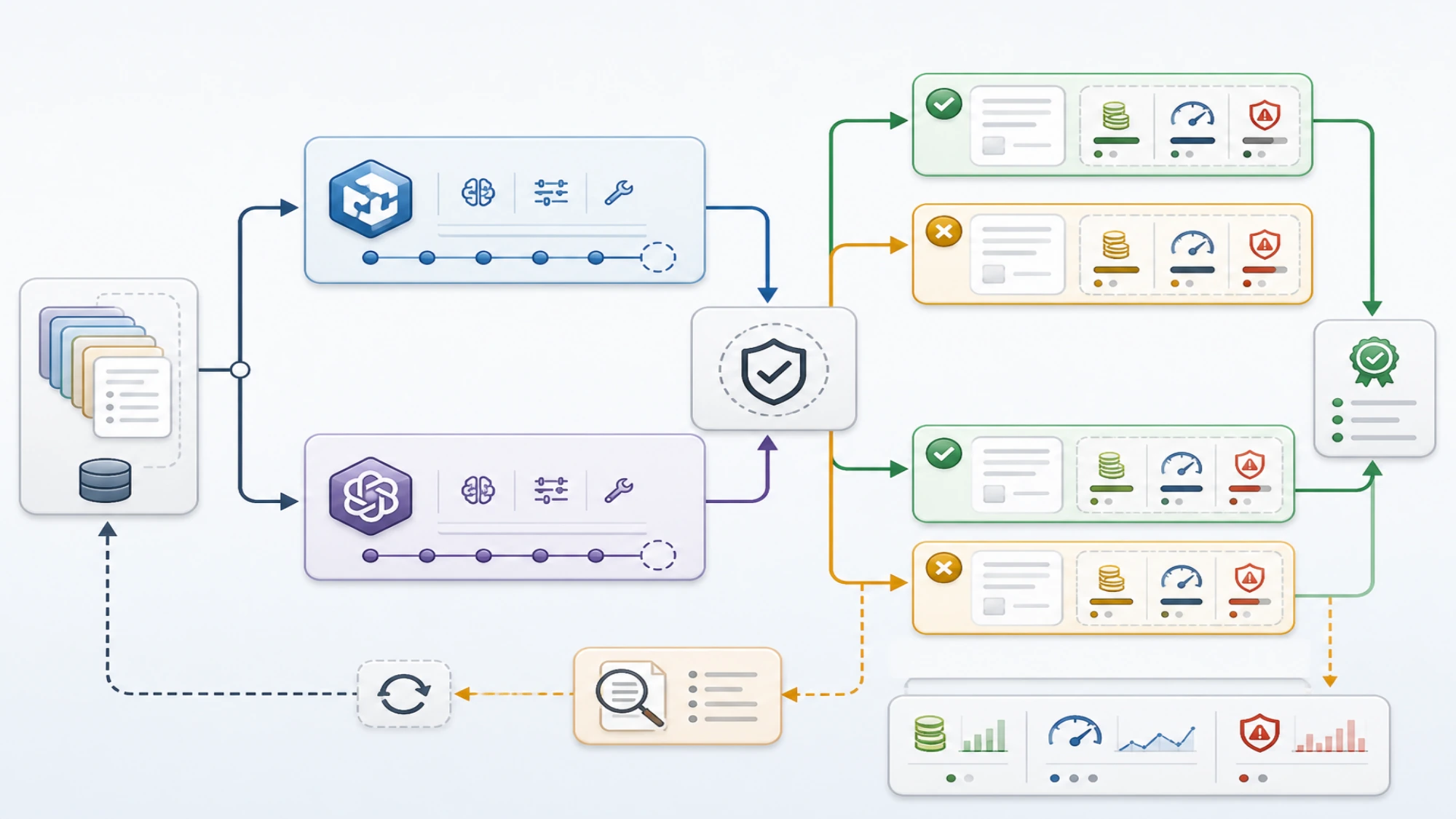
Calculate the metric that procurement actually needs:
accepted-task cost = (model charges + retry charges + validation cost + repair cost) / accepted tasks
If a configuration produces zero accepted tasks, report that failure directly; do not let a cost calculation obscure it. Then add two guardrails: p95 latency for the user experience and critical-failure rate for operational risk. A model wins your evaluation only if it meets the quality floor and improves the metric you care about without crossing either guardrail.
Precommit to a decision rule
Use a decision rule written before the test. For example:
- Ship DeepSeek V4 Pro if it stays within two percentage points of Sol’s accepted-task rate, cuts accepted-task cost by at least 40%, and meets the latency target.
- Ship GPT-5.6 Sol if it improves the accepted-task rate by at least five points on critical cases and the improvement is worth the measured incremental cost.
- Route by workload if one model dominates visual or high-complexity cases while the other handles high-volume text tasks more economically.
- Ship neither if both miss the critical-failure ceiling; change the workflow, validation layer, or task decomposition before spending more on model selection.
The thresholds above are examples, not claims about either model. Replace them with values tied to your error budget and unit economics.
Your next step
There is a clean first-test answer, but not a universal winner.
Choose DeepSeek V4 Pro first for a cost- or responsiveness-constrained API evaluation. Choose GPT-5.6 Sol first when documented image input or an existing OpenAI integration is the gating requirement. If the real question is which model produces better accepted work, test both on the same task set, disclose configuration differences, and verify final state.
That approach preserves what the public facts can tell you—identity, interface, context, output limits, prices, and attributed measurements—without pretending they answer the one question only your workload can settle.