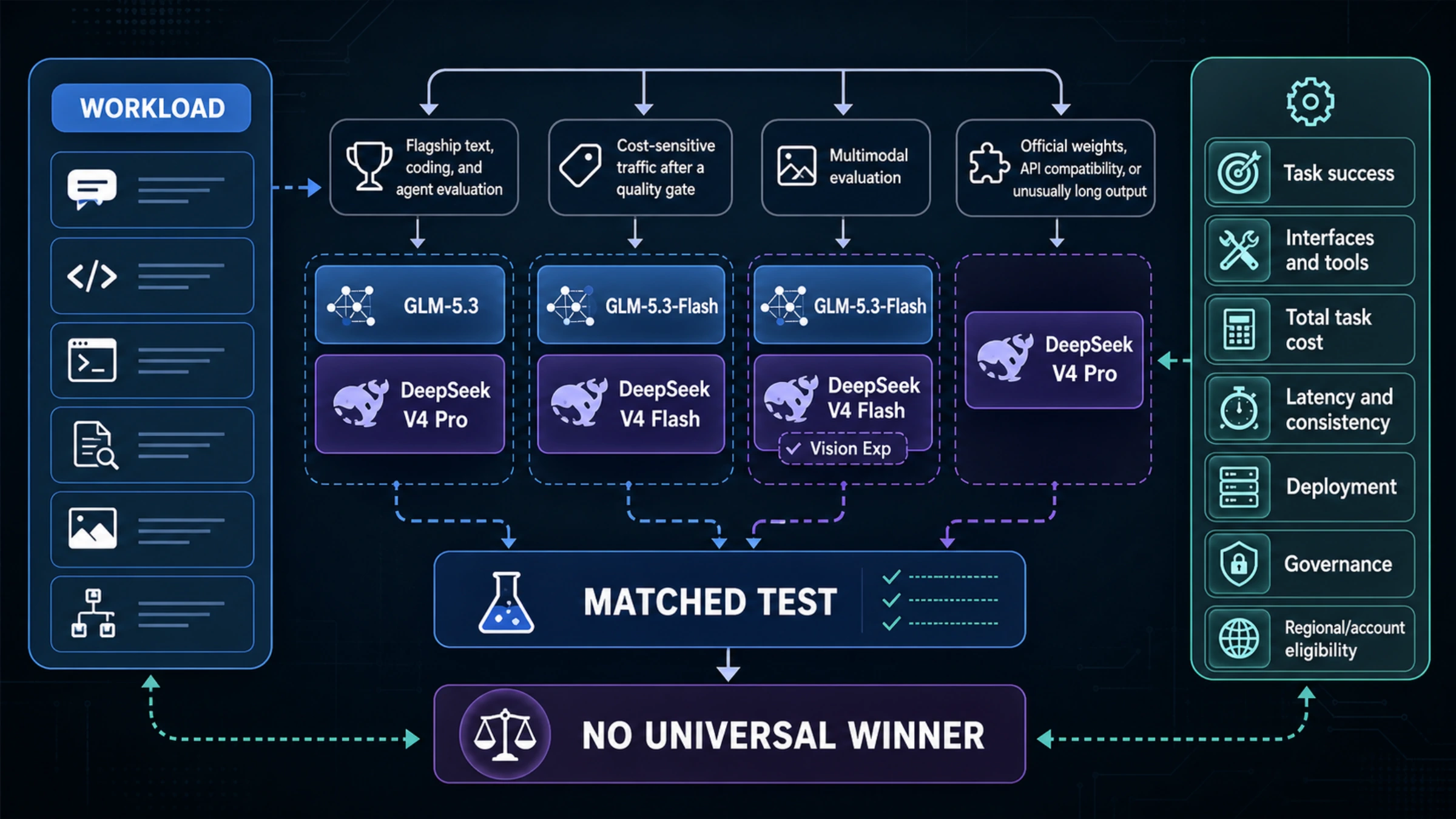
The short answer: choose GLM-5.3 as a serious candidate for text-heavy coding and long-running agent workflows; choose DeepSeek-V4-Pro-0813 when you want its broader documented API compatibility, longer maximum output, or published weights for local deployment. For multimodal input, compare GLM-5.3-Flash with DeepSeek-V4-Flash-Vision-Exp—but treat the latter as experimental. Do not declare either family the universal winner until both have passed the same tasks, tools, budgets, and acceptance tests in your environment.
That answer is less dramatic than a benchmark leaderboard, but it is more useful. “GLM vs DeepSeek” is no longer one stable model pair: both vendors now expose several tiers, and comparisons that still center GLM-4.x, GLM-5.2, DeepSeek R1, or DeepSeek V3 can mislead a current purchasing decision.
This guide reflects public information checked on August 27, 2026. Prices, served versions, promotions, account eligibility, and regional terms can change, so recheck the linked official pages before committing spend.
First, compare the right models
| Current option | What the public contract establishes | Most sensible first evaluation |
|---|---|---|
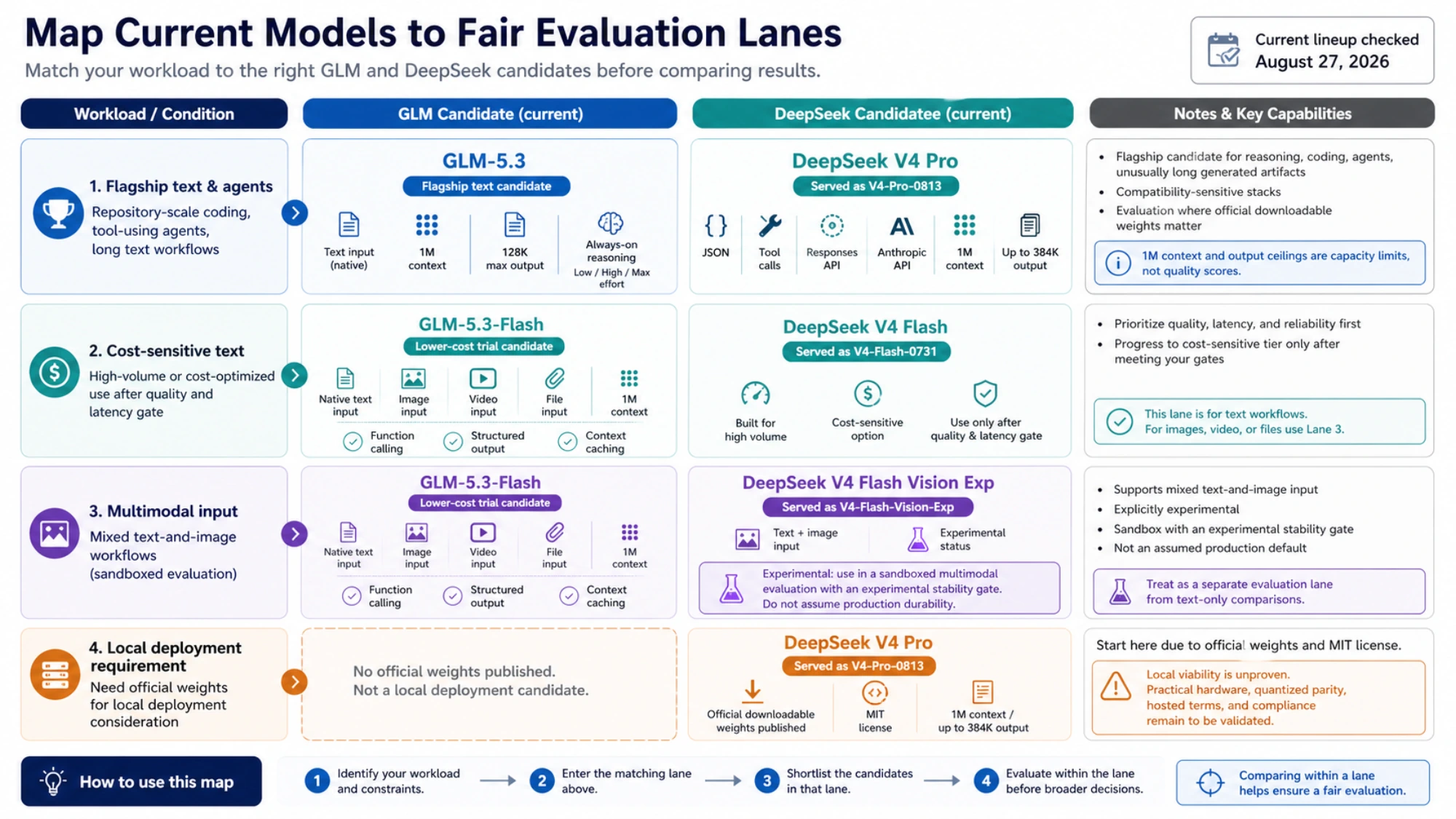
GLM-5.3 (glm-5.3) | Z.ai's latest flagship; text input; 1M-token context; 128K maximum output; always-on reasoning with low, high, or max effort | Repository-scale coding, tool-using agents, long text workflows |
GLM-5.3-Flash (glm-5.3-flash) | Native text, image, video, and file input; 1M-token context; function calling, structured output, and context caching | Multimodal extraction and lower-cost workflow trials |
DeepSeek V4 Pro (deepseek-v4-pro, served as V4-Pro-0813 on the checked page) | 1M-token context; up to 384K output; JSON, tool calls, Responses API, and Anthropic API; low, high, or max reasoning effort | Reasoning, coding, agents, very long generated artifacts, compatibility-sensitive stacks |
DeepSeek V4 Flash (deepseek-v4-flash, served as V4-Flash-0731) | A lower-tier V4 option with the same documented interface family | High-volume routing after a quality and latency gate |
DeepSeek V4 Flash Vision Exp (deepseek-v4-flash-vision-exp) | Mixed text-and-image input through an explicitly experimental endpoint | Sandboxed multimodal evaluation, not an assumed production default |
The specifications above come from the current GLM-5.3 documentation, GLM-5.3-Flash documentation, and DeepSeek API pricing and model table. A large context window is only a capacity limit; it does not prove reliable retrieval across the whole prompt. Likewise, a large output ceiling does not mean that generating near that ceiling is economical or useful.
Do not compare mismatched tiers
A clean evaluation starts with the job, not the brand:
- Flagship text reasoning and coding: GLM-5.3 versus DeepSeek V4 Pro.
- Cost-sensitive text traffic: GLM-5.3-Flash versus DeepSeek V4 Flash, provided your tasks do not require capabilities the cheaper tier fails.
- Multimodal input: GLM-5.3-Flash versus DeepSeek V4 Flash Vision Exp, with an explicit stability gate for the experimental DeepSeek endpoint.
- Local deployment: begin with DeepSeek V4 Pro if official downloadable weights and an MIT license are hard requirements. DeepSeek publishes V4-Pro-0813 weights and deployment guidance. This does not establish affordable hardware, hosted-endpoint terms, quantized parity, or compliance for your organization.
Where the evidence points—and where it stops
Both vendors report meaningful gains for their newest models. Z.ai reports better coding and long-horizon agent performance for GLM-5.3 over GLM-5.2; DeepSeek reports gains for V4 Pro under documented but vendor-controlled test conditions. Those claims are useful release evidence, not an apples-to-apples verdict: the vendors do not share one endpoint class, harness, effort level, tool budget, or evaluator.
The strongest current independent signal in the reviewed evidence is narrower. Aikido Security tested ten models on 32 recently disclosed vulnerabilities, with frozen prompts and tools, no internet access, and three runs per case. In that cybersecurity-discovery harness, DeepSeek V4 Pro found more pooled vulnerabilities than GLM-5.3, while producing more candidate findings and false leads. Read the methodology and results before applying the finding.
This supports a bounded conclusion: DeepSeek V4 Pro deserves a place in a security-discovery bake-off, especially when recall matters. It does not prove that DeepSeek is better for general reasoning, application coding, multimodal analysis, latency, or every security workflow. More candidates can also mean more analyst review.
No sufficiently repeated, independent evaluation was established here that compares GLM-5.3 and DeepSeek V4 Pro across general reasoning, repository coding, agents, multimodal work, latency, safety, and total cost under fully matched conditions. Any broad winner claim therefore goes beyond the available evidence.
GLM vs DeepSeek pricing: token rates are not task cost
The checked public USD list prices make the trade-off look simple, but only until cache behavior, time bands, retries, tools, and failed outputs enter the bill.
| Model and condition | Input per 1M tokens | Cached/cache-hit input | Output per 1M tokens |
|---|---|---|---|
| GLM-5.3 | $1.40 | $0.26 | $4.40 |
| DeepSeek V4 Pro, off-peak | $0.66 cache miss | $0.022 | $1.98 |
| DeepSeek V4 Pro, peak | $1.32 cache miss | $0.044 | $3.96 |
| GLM-5.3-Flash promotional rate | $0.075 | $0.015 | $0.25 |
The GLM-5.3-Flash rate was advertised as a 50% promotion ending September 9, 2026 at 24:00 UTC+8. Verify the current Z.ai pricing page before using it in a forecast. DeepSeek's rates vary between peak and off-peak periods; check its current pricing table for the applicable schedule and served model.
Use a workload-level estimate instead of comparing one column:
textestimated task cost =
  cache-miss input tokens × miss rate
  + cache-hit input tokens × hit rate
  + output tokens × output rate
  + retry and tool-call token cost
  + human review or rework cost
For example, a model with a lower output rate can still cost more if it takes several attempts to produce an acceptable patch. A more expensive model can be cheaper per merged change if it succeeds with fewer retries and less review. Public list prices also do not settle taxes, exchange rates, payment eligibility, enterprise discounts, or regional availability.
A scenario-based choice
Agentic coding and repository work
Start with GLM-5.3 and DeepSeek V4 Pro as the matched flagship candidates. GLM-5.3's public contract and vendor positioning make it a credible long-horizon agent candidate. DeepSeek V4 Pro offers native Responses API support and an Anthropic-compatible interface alongside tool calls, which may reduce integration work in an existing stack.
Test them on the same repository snapshot. Require both models to inspect the same files, use the same tools, stay within the same token and time budgets, and pass the same test suite. Measure accepted patches—not aesthetically pleasing explanations.
General reasoning and document production
DeepSeek V4 Pro's documented maximum output of up to 384K is attractive when unusually long generation is a real requirement; GLM-5.3 documents 128K maximum output. Treat both numbers as ceilings, not quality guarantees. Evaluate factual accuracy, instruction retention, citation handling, and performance at the context lengths you actually use.
Multimodal extraction and analysis
GLM-5.3-Flash is the lower-risk first candidate on public product status because Z.ai documents it as a native multimodal GLM-5 model rather than an experimental endpoint. DeepSeek's vision-capable V4 Flash option supports mixed text and image input, but its August 21 release labels it experimental.
That status difference does not prove a quality difference. Test your own scans, screenshots, charts, or product images, including corrupted files and ambiguous inputs. For production, add a fallback and define what happens when the vision endpoint changes or fails.
Cybersecurity discovery
Put DeepSeek V4 Pro on the shortlist because it led GLM-5.3 on pooled vulnerability discovery in the cited Aikido harness. Also score precision, duplicate findings, exploit validity, analyst minutes per confirmed issue, and run-to-run consistency. If false leads are costly, recall alone is the wrong target.
Self-hosting and controlled infrastructure
DeepSeek V4 Pro has a concrete advantage at the starting line: official weights are published under the MIT License. But “weights available” is not the same as “practical to deploy.” Before choosing it, price the necessary accelerators, serving stack, quantization, throughput, observability, patch cadence, and security review. Compare that total with hosted endpoints under your actual volume.
Run a small matched bake-off before you commit
A useful bake-off can be small. Ten to thirty representative tasks, repeated enough to expose inconsistency, are more informative than hundreds of unrelated benchmark questions.
- Freeze the task set. Sample real repository changes, reasoning cases, documents, images, or security targets. Keep a hidden acceptance set where possible.
- Match the conditions. Use comparable reasoning effort, prompts, tool permissions, timeouts, context, retry policy, and maximum spend.
- Define acceptance before running. Prefer test pass rate, schema validity, factual checks, verified findings, and reviewer time over subjective preference.
- Record the whole task cost. Capture input, cached input, output, tool calls, retries, latency, failures, and human correction time.
- Repeat and inspect variance. A model that succeeds once and fails twice may be worse for automation than a slightly weaker but steadier model.
- Check operational fit. Confirm account access, payment, data retention, training use, service terms, rate limits, and procurement requirements directly with the provider.
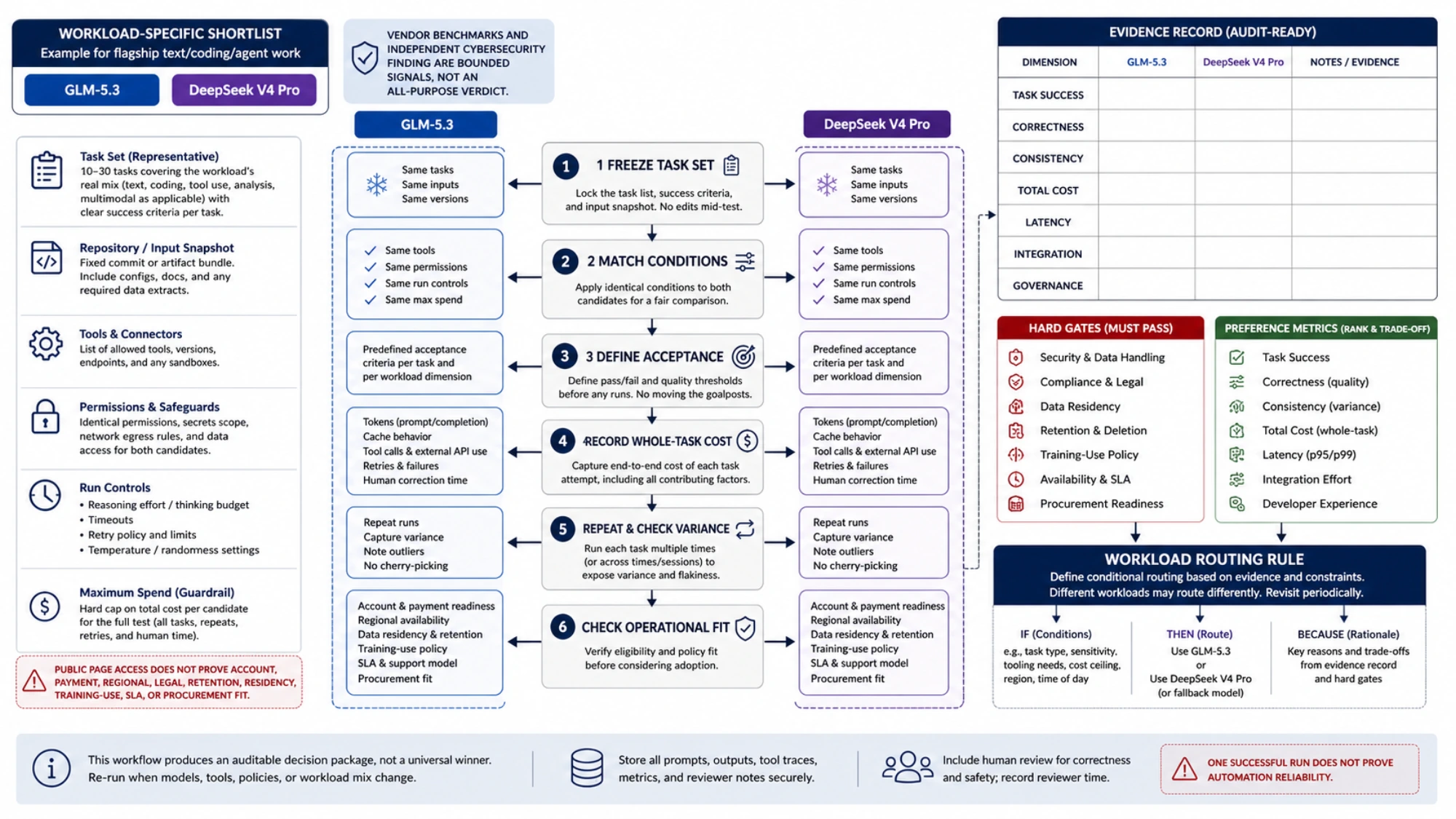
Use a scorecard that keeps hard gates separate from preferences:
| Measure | Example acceptance rule |
|---|---|
| Task success | Automated tests pass; required artifacts exist; no prohibited changes |
| Correctness | Claims match a trusted reference or human adjudication |
| Consistency | Success rate across repeated runs clears your automation threshold |
| Total cost | Model spend plus expected review time stays within budget |
| Latency | p50 and p95 completion time meet the user-facing or batch SLA |
| Integration | Required protocol, tools, JSON, streaming, and error handling work in your client |
| Governance | Contract, retention, residency, access, and audit requirements are satisfied |
Practical recommendation
If you need a default shortlist today:
- Evaluate GLM-5.3 and DeepSeek V4 Pro together for high-value text, coding, and agent tasks.
- Prefer GLM-5.3-Flash as the first production-oriented multimodal candidate, while testing DeepSeek V4 Flash Vision Exp in an isolated path until its experimental status and your stability results change.
- Give DeepSeek V4 Pro extra weight for current cyber-discovery evaluation, very long output needs, broad API compatibility, or official-weight deployment—but verify the workload-specific trade-offs.
- Use a Flash tier only after it passes your quality floor; a low token rate cannot rescue failed tasks.
The best choice may also be routing rather than loyalty: use a cheaper tier for low-risk, well-validated requests and escalate difficult or high-impact work to the flagship that performs better in your tests. Keep the routing rule tied to observed outcomes, not vendor labels.
FAQ
Is GLM cheaper than DeepSeek?
Not as a general statement. The checked GLM-5.3-Flash promotional rates are very low, while DeepSeek V4 Pro has peak/off-peak and cache-hit/cache-miss rates. Different tiers, cache behavior, output length, retries, and review time can reverse the result. Calculate cost per accepted task.
Is GLM-5.3 better than DeepSeek V4 Pro for coding?
The available evidence does not establish a universal coding winner under a fully matched current-generation harness. Both belong in a repository-specific test. Judge test-passing patches, consistency, latency, and total review cost.
Which one should I use for images?
Start by evaluating GLM-5.3-Flash and DeepSeek V4 Flash Vision Exp on your own image tasks. GLM-5.3-Flash has the safer public status for a production shortlist; DeepSeek's option was explicitly experimental as of August 27, 2026. Neither status nor a vendor benchmark substitutes for testing your inputs.
Can I self-host the latest models?
DeepSeek publishes V4-Pro-0813 weights under the MIT License with deployment guidance. Practical self-hosting still depends on hardware, quantization, serving software, throughput, and compliance. Equivalent current GLM checkpoint and hardware terms were not fully normalized in the evidence used for this comparison, so verify them directly rather than assuming symmetry.
What should I verify immediately before launch?
Recheck the exact served model ID, current price and time band, promotion expiry, rate limits, region and payment eligibility, data terms, and endpoint feature support. Then rerun a small acceptance suite against the production endpoint. Public documentation confirms a product contract; only your matched test confirms fit for your workload.
Bottom line
The defensible 2026 answer is not “GLM wins” or “DeepSeek wins.” It is: map the current tiers correctly, shortlist the models whose public contracts fit the job, and let a matched workload test decide. GLM-5.3 is a credible flagship for coding and agent evaluation, GLM-5.3-Flash is a strong multimodal and cost-sensitive candidate, and DeepSeek V4 Pro stands out for interface breadth, output ceiling, official weights, and a promising but narrow independent cybersecurity result. Your production winner is the one that clears your quality, cost, reliability, and governance gates at the same time.