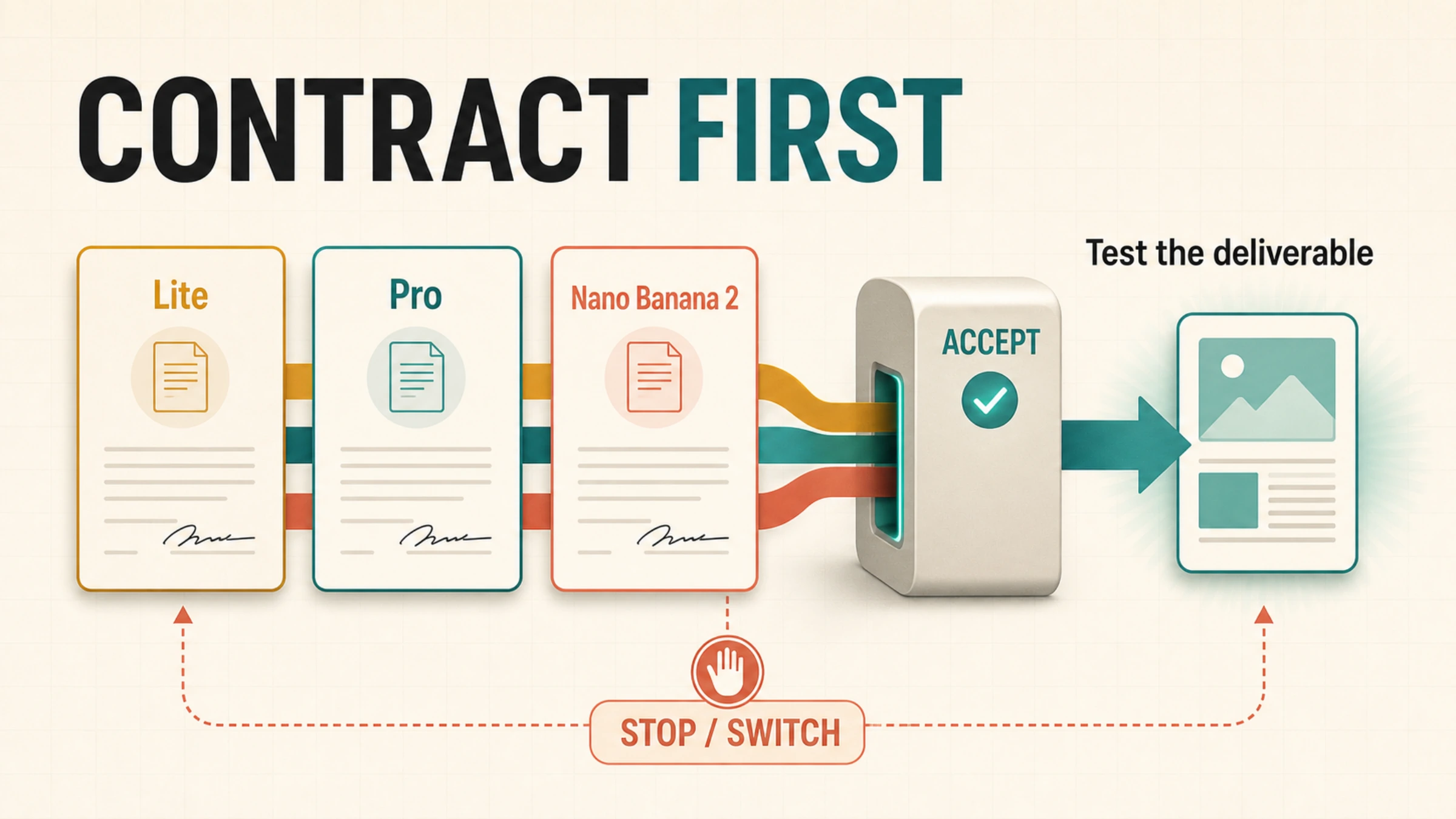
The first decision is not Seedream 5 versus Nano Banana 2. It is which Seedream 5 API model the provider actually exposes.
- Start with Seedream 5.0 Lite when streaming, 2K-to-4K output, a larger reference allowance, or its flat direct charge per successfully output image fits the production constraint.
- Include Seedream 5.0 Pro when its 1K, 1.5K, or 2K contract fits the required handoff; do not assume it is Lite with every limit increased.
- Start with Nano Banana 2 when 0.5K-to-4K sizing, Search grounding, conversational editing, or Google's documented object and character reference categories remove a real input barrier.
Those are evidence-backed starting routes, not quality rankings. Typography, identity, product fidelity, layout, latency, and repair effort remain workload-specific. The purchase decision should end with accepted files and comparable units—not a favorite launch sample or an undefined “cheaper” claim.
Resolve the three contracts before comparing outputs
BytePlus documents two current Seedream routes, while Google identifies Nano Banana 2 as a separate Gemini API model. Record the exact ID from the request or provider response rather than trusting a storefront label.
| Contract | Current documented identity | Output and workflow boundaries |
|---|---|---|
| Seedream 5.0 Lite | seedream-5-0-260128, also seedream-5-0-lite-260128 | 2K, 3K, 4K; streaming; up to 14 reference images |
| Seedream 5.0 Pro | dola-seedream-5-0-pro-260628 | 1K, 1.5K, 2K; no streaming; up to 10 reference images |
| Nano Banana 2 | gemini-3.1-flash-image | 0.5K, 1K, 2K, 4K; Search grounding and multi-turn editing; up to 10 high-fidelity object references and 4 character references |
The current BytePlus generation guide says Pro's 1.5K tier has the same price as 1K and gives BytePlus's own quality positioning for that tier. That vendor statement does not prove Pro will beat Lite or Nano Banana 2 on your assets. Google's Gemini image guide likewise documents capabilities, not a comparative acceptance rate.
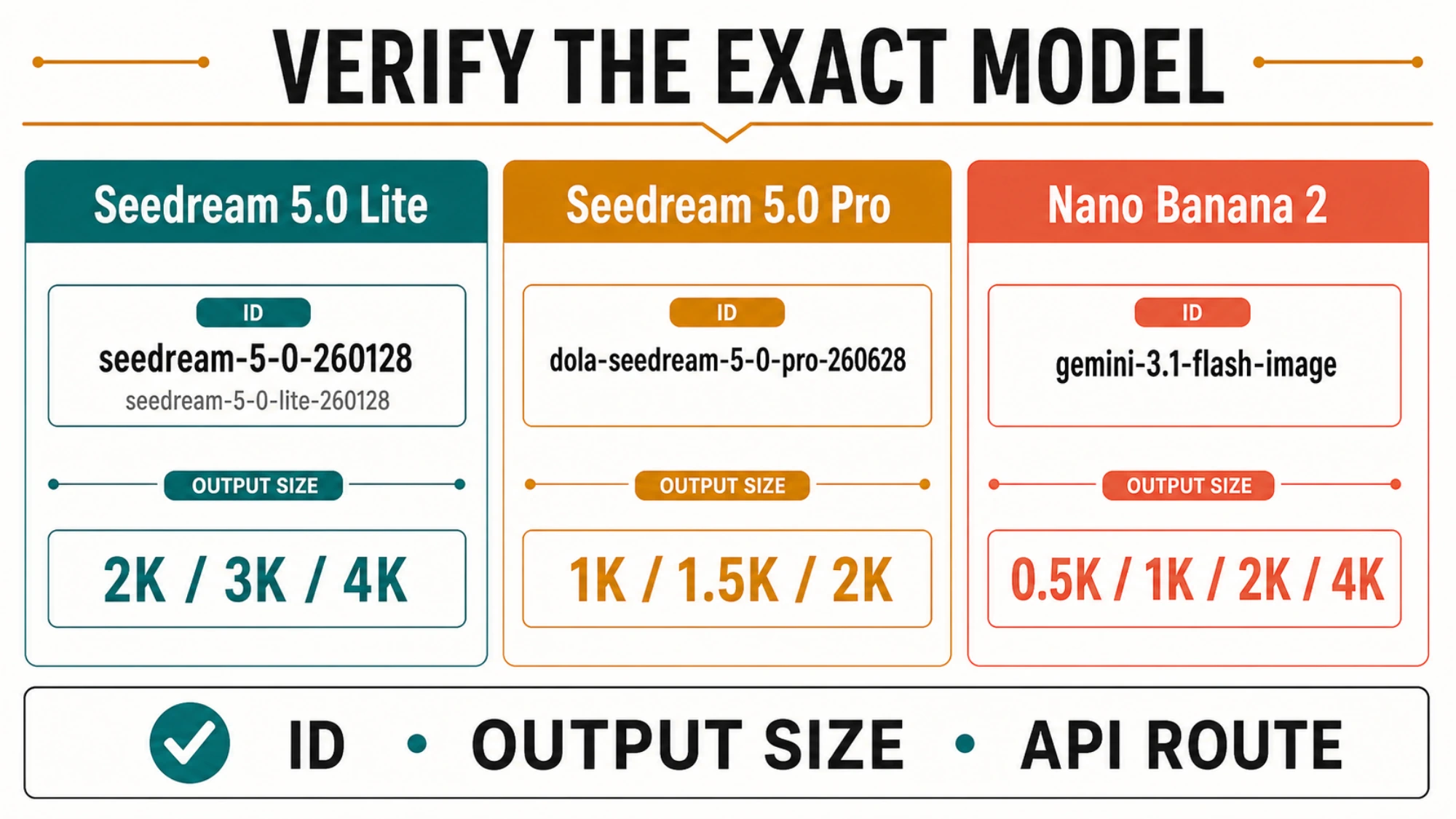
If a gateway exposes only “Seedream 5,” inspect the outgoing model ID, maximum output size, streaming behavior, reference limit, and billing policy. If the service hides those fields, its images may still be useful, but its price and results cannot stand in for every Seedream integration.
Let a hard failure narrow the field
Write one sentence that would cause the asset to be rejected. “It looks worse” is not testable; “the legal line changes one digit,” “the fourth character loses identity,” or “the file is below the required size” is.
Use Nano Banana 2 when its context or edit path removes a barrier
Nano Banana 2 supports 0.5K, 1K, 2K, and 4K output, Web and Image Search grounding, and multi-turn editing. Google's working categories include up to ten high-fidelity objects and four characters.
That makes it a defensible first test for a Search-informed visual, a conversational revision sequence, or a job whose resolution range does not fit the surviving Seedream route. Grounding is not a factuality warranty, and reference maxima are not identity guarantees. Check every date, label, object, and protected region before acceptance.
Use Seedream 5.0 Lite when throughput is the bottleneck
Lite's streaming support, 2K-to-4K range, and allowance of up to 14 reference images fit concept batches, related campaign assets, and reference-heavy exploration. BytePlus currently lists $0.035 per successfully output image and says outputs blocked before a successful output are not billed.
Successfully output does not mean approved. An image that arrives but fails typography, identity, or product review can still consume the posted output charge and human time.
Use Seedream 5.0 Pro when the actual Pro contract fits the handoff
Pro is a different route, not a premium switch on Lite. Its documented range is 1K, 1.5K, and 2K; it does not stream, and its reference ceiling is lower than Lite's. BytePlus says 1.5K costs the same as 1K and presents 1.5K as the better-quality option within Pro. That is vendor guidance for selecting a Pro tier, not evidence that Pro beats Lite or Nano Banana 2 on a particular asset.
Verify that the provider exposes the control you intend to buy. If the job does not use a Pro-specific boundary, the word “Pro” alone is not evidence that the delivered asset will need less repair.
Normalize the price before calling a route cheaper
Current direct API prices, checked August 9, 2026, have different shapes:
| Route and mode | Published image-output price |
|---|---|
| Seedream 5.0 Lite | $0.035 per successfully output image |
| Seedream 5.0 Pro | $0.045 at or below 2.61 million pixels, described as 1.5K or lower; $0.090 above 2.61 million pixels |
| Nano Banana 2 Standard | $0.045 at 0.5K; $0.067 at 1K; $0.101 at 2K; $0.151 at 4K |
| Nano Banana 2 Batch | $0.022 at 0.5K; $0.034 at 1K; $0.050 at 2K; $0.076 at 4K |
Sources: BytePlus ModelArk pricing and Gemini Developer API pricing. For Seedream Pro, the first input image is free and each input from the second costs $0.003. For Nano Banana 2, image input, text or thinking output, grounding, and other billable activity can add cost. Provider markup, tax, review, and repair sit outside both headline tables.
Do not describe Nano Banana 2 Batch as exactly half price at every size: the published rounded values are close to half but not identical in every row. Do not compare Seedream Lite at one setting with Nano Banana 2 at 4K unless those are the actual delivery settings.
Use denominators that can be audited:
API cost per accepted asset = total API spend / accepted assetsrepair minutes per accepted asset = total repair minutes / accepted assets- If an hourly labor rate is available,
completed-asset cost = API cost per accepted asset + repair minutes per accepted asset / 60 × hourly labor rate
Without a labor rate, report dollars and minutes separately. Adding “$0.10 per asset” to “12 minutes of repair” produces no meaningful number.
Build the pilot from real risks, not a magic sample count
The pilot should cover the ways this deliverable can fail. A practical menu includes exact copy, a protected product, identity across edits, a multi-reference scene, a numeric graphic, a localized edit, and the final ratio or resolution. Use only the cases that belong to the job, then repeat the highest-variance ones as the budget and consequence justify.
Set the cap before generating. A low-risk social variant may need a small time or dollar allowance; a high-value catalog or campaign asset may justify more repetitions. One output per prompt can reveal a failure mode, but it cannot estimate a stable acceptance rate.
For surviving routes, keep the source assets, required size, approved text, and pass criteria equivalent. Equal attempt counts are not mandatory when the APIs expose different native workflows; a comparable dollar or time budget may be fairer. Save every billed output, rerun, and repair—not only the strongest image.
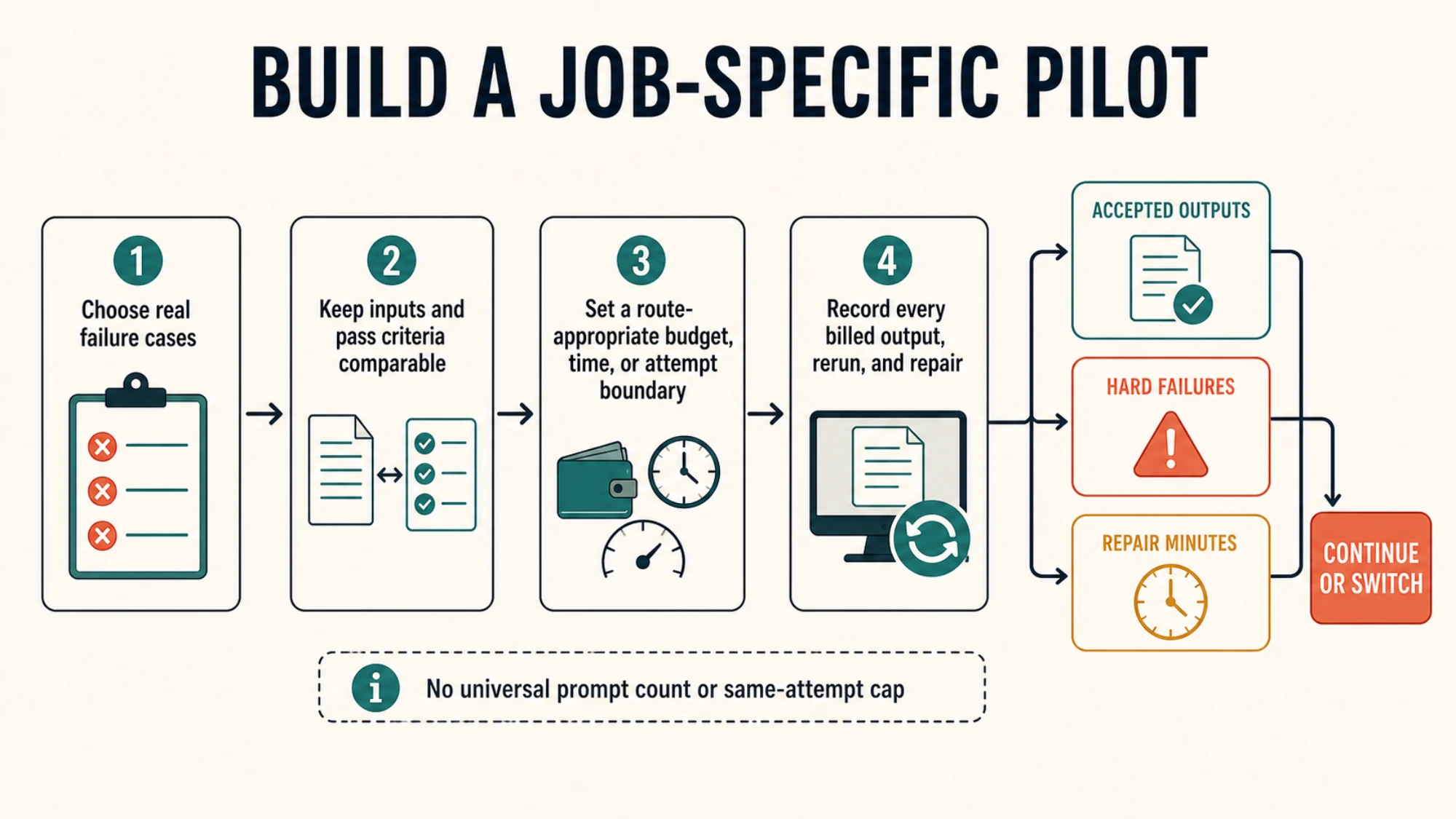
Stop when the predeclared budget or deadline is exhausted, when a hard requirement proves unsupported, or when the remaining uncertainty no longer changes the purchase. Do not turn “two failures” or any other convenient number into a universal rule.
Treat public examples as scoped evidence
A PiAPI comparison showed one output from each route for three prompts and reported stronger realism, structured alignment, and local detail from its Nano Banana 2 path, while its Seedream 5.0 Lite outputs looked more stylized. That is useful for selecting risks to inspect.
It is not a universal verdict: the provider sample did not compare Seedream 5.0 Pro, repeat variance, pass criteria, repair time, or direct-provider contracts. Your accepted-asset record should override a provider's first-output preference.
Choose the first route, then keep the result conditional
Start with Lite when streaming, reference-heavy exploration, or its 2K-to-4K production shape matches the job. Start with Nano Banana 2 when grounding, conversational editing, its reference categories, or its wider resolution ladder removes a hard barrier. Include Pro when the documented Pro contract and controls solve a requirement that Lite cannot simply inherit.
A staged setup can be sensible—one route for exploration and another for a constrained final—but only when the handoff saves more retries or repair than it adds. Lock the exact IDs, compare like with like, and let accepted assets decide the production route.