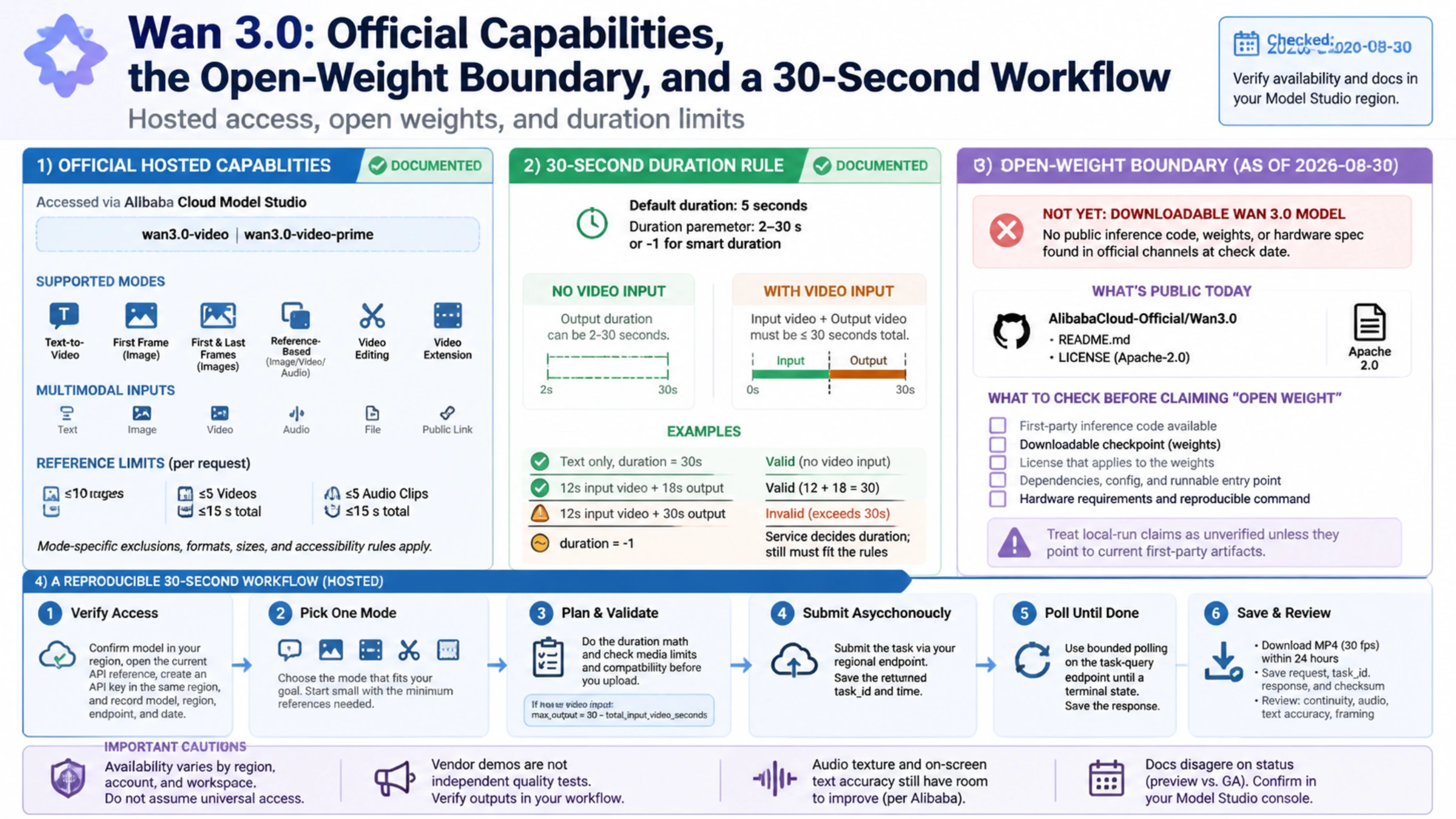
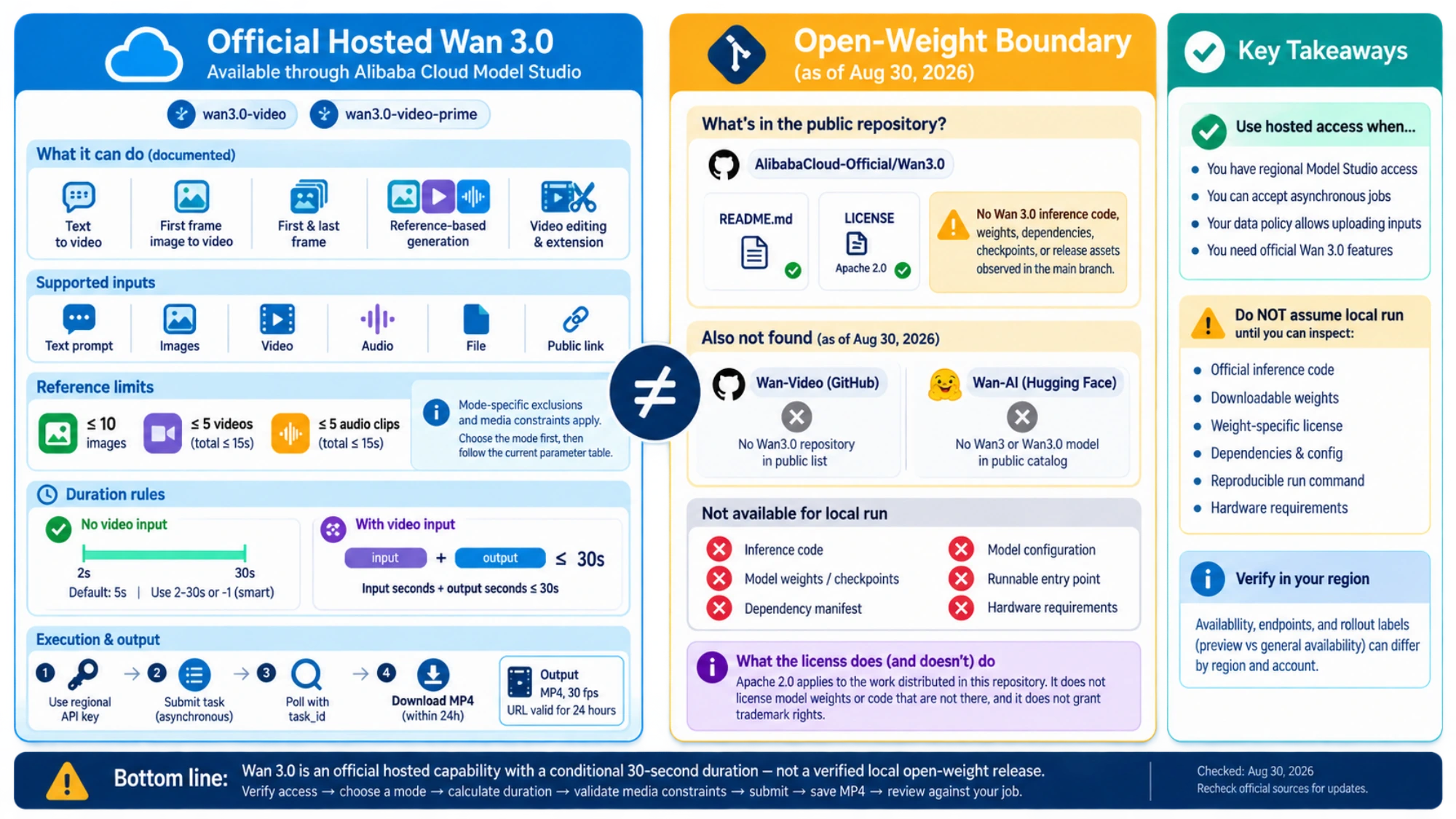
Wan 3.0 is available as a hosted video-generation service through Alibaba Cloud Model Studio. Its documented model IDs are wan3.0-video and wan3.0-video-prime, with text, image, video, audio, file, and public-link inputs supported across several generation and editing modes.
That does not currently make Wan 3.0 a downloadable, locally runnable open-weight model. As checked on August 30, 2026, the public AlibabaCloud-Official/Wan3.0 repository contained only a README and an Apache 2.0 license. No Wan 3.0 inference code, dependency manifest, checkpoint, release asset, or local hardware requirements were publicly present in that tree. The official Wan-Video GitHub organization and Wan-AI Hugging Face catalog also showed no Wan 3.0 code or model repository at that time.
And “30 seconds” needs one important qualifier: without video input, the documented output duration can be an integer from 2 to 30 seconds. With video input, input-video duration plus output-video duration must be no more than 30 seconds. It is not automatically 30 additional seconds.
The status in one minute
| Question | Evidence-backed answer |
|---|---|
| Is there an official Wan 3.0 service? | Yes. Alibaba Cloud documents wan3.0-video and wan3.0-video-prime in Model Studio. Access still depends on region, account, and workspace eligibility. |
| What can the hosted models do? | The API reference covers text-to-video, first-frame and first/last-frame image-to-video, reference-based generation, video editing, and video extension. |
| Is Wan 3.0 open source or open weight? | The public repository is Apache-2.0-licensed, but only the files actually distributed there receive that license. At the check date, it did not distribute Wan 3.0 inference code or weights. |
| Can I run Wan 3.0 locally? | No official local package, weights, hardware specification, or verified local workflow was available in the checked public channels. Treat local-run claims as unverified unless they point to a current first-party artifact. |
| Does it always generate a 30-second output? | No. The default duration is 5 seconds. The range is 2–30 seconds without video input; video input and generated output must fit within a 30-second total. -1 requests smart duration. |
| Is the output independently proven to be production-ready? | No. This article did not independently test quality, latency, or failure rate. Alibaba also says audio texture and on-screen text accuracy still have room to improve. |
Official public pages are also inconsistent about rollout status: the API reference labels the service “currently in preview,” while the model release page says the API is generally available. Do not infer a universal SLA or entitlement from either label. Check the model catalog in the exact Model Studio region and account you will use.
What “official capability” means here
The safest capability baseline is the Wan 3.0 API reference, not a generator landing page or a showcase video. It documents an All-in-One hosted model family with these input paths:
- Prompt only: generate video from a text description.
- First frame or first and last frames: use images to constrain the opening, or both ends, of a clip.
- Reference media: provide reference images, videos, or audio for the supported reference-based mode.
- File or public link: use supported documents, media files, or an accessible URL where the selected mode permits it.
- Video input: edit or extend video within the documented constraints.
The reference limits include up to 10 images, up to 5 videos totaling no more than 15 seconds, and up to 5 audio clips totaling no more than 15 seconds. Those maxima are not permission to mix every asset type in every request. First/last-frame modes and reference, file, and link modes have mutual-exclusion rules, and each media type has its own format, size, dimension, and accessibility requirements. Choose the mode first; then follow the current parameter table for that mode.
Alibaba markets Wan 3.0 as supporting native 30-second storytelling, integrated audio, editing, improved consistency, and up to 20 multimodal reference assets. Those are vendor claims, not independent benchmark results. The documented request limits and your own output checks should govern a production decision.
The open-source boundary: license the artifact, not the brand name
“There is a GitHub repository with an Apache 2.0 license” and “the model is available under Apache 2.0” are different statements.
At the time of the check, the public main branch of AlibabaCloud-Official/Wan3.0 had exactly two files: README.md and LICENSE. The license applies to the work actually distributed in that repository, subject to its terms. It cannot license model weights or inference code that are not there, and it does not grant trademark rights.
The practical test is artifact-based:
- Is there first-party inference code?
- Is there a downloadable checkpoint from an official organization?
- Is there a license that clearly applies to those weights?
- Are dependencies, model configuration, and a runnable entry point present?
- Are hardware requirements and a reproducible local command documented?
For Wan 3.0, the checked public channels did not satisfy that chain. This is a dated observation, not a claim that Alibaba will never publish those artifacts. Recheck the official repository, the Wan-Video organization, and the Wan-AI model catalog before making a local-deployment decision.
If you need local inference today, select a model whose official weights, code, applicable license, and hardware path you can inspect now. Do not download a file labeled “Wan 3.0” from an unaffiliated mirror and assume it is the hosted model.
Calculate the duration before you build the request
The duration rule is simple enough to put in a preflight check:
textif request_has_video_input:
    maximum_output_seconds = 30 - total_applicable_input_video_seconds
else:
    maximum_output_seconds = 30
The documented duration default is 5 seconds. Without video input, use an integer from 2 through 30, or -1 for smart duration. With video input, keep the relevant input-video time and requested output within the 30-second ceiling.
Examples:
| Request | Duration decision |
|---|---|
Text prompt only, duration: 30 | Fits the documented no-video range. |
First-frame image plus duration: 30 | No video input is involved; confirm the image mode's current constraints, then request up to 30 seconds. |
| 12-second video input plus 18-second output | Fits the 30-second combined limit. |
| 12-second video input plus 30-second output | Invalid under the combined-duration rule; reduce output to 18 seconds or less. |
duration: -1 | Delegates duration selection to the service; it does not remove the media or total-duration constraints. |
Do this arithmetic before upload. It avoids spending time on a request that cannot satisfy the duration boundary.
A reproducible hosted workflow for an up-to-30-second job
This workflow deliberately avoids hard-coding a regional hostname. Alibaba requires the API key, model, and endpoint to belong to the same region, and the valid host and account permissions can differ by workspace.
1. Verify the access surface
In your target Model Studio region:
- confirm that
wan3.0-videoorwan3.0-video-primeappears for your account; - open the current API reference from that region;
- create or select an API key in the same region as the endpoint;
- record the model ID, region, endpoint, and the documentation check date.
If the model is missing, stop. A third-party page saying the API is live does not establish access in your account.
2. Pick one request mode
Start from the control you actually need:
- use text-to-video when no visual identity must be preserved;
- use first-frame mode when the opening image is the anchor;
- use first/last-frame mode when both endpoints matter;
- use reference-based generation when supported reference media should guide identity, motion, or sound;
- use editing or extension when an existing video is the object of the task.
Do not begin by attaching every available asset. A smaller, valid reference set is easier to diagnose and reproduce.
3. Create a request worksheet
Before translating the plan into the current SDK or REST schema, fill in a neutral worksheet like this:
json{
  "region": "YOUR_MODEL_STUDIO_REGION",
  "model": "wan3.0-video",
  "mode": "SELECT_ONE_SUPPORTED_MODE",
  "prompt_goal": "Describe subject, action, setting, camera behavior, sound, and ending",
  "media_inventory": {
    "images": 0,
    "video_count": 0,
    "total_video_seconds": 0,
    "audio_count": 0,
    "total_audio_seconds": 0
  },
  "requested_output_seconds": 0,
  "acceptance_checks": [
    "duration",
    "subject and prop continuity",
    "audio synchronization",
    "on-screen text accuracy",
    "final-frame match"
  ]
}
This is a planning object, not an API payload. Map it to the exact field names and mutual-exclusion rules in the current official reference. Check, at minimum, image count, video count and total seconds, audio count and total seconds, the combined duration rule, media accessibility, and mode compatibility.
4. Submit asynchronously and keep the task ID
Wan 3.0 generation is asynchronous. Submit the task using the current regional endpoint, then persist the returned task_id with the request worksheet and submission time. Poll the official task-query endpoint until the task reaches a terminal state.
Use bounded polling rather than a tight loop. Preserve the terminal response whether it succeeds or fails; an error body is part of the reproducibility record.
5. Save the successful result immediately
The documented successful output is an MP4 at 30 fps, and the returned video URL is valid for 24 hours. Download it as soon as the task succeeds. For example:
bashcurl --fail --location "$RESULT_URL" --output wan3-result.mp4
shasum -a 256 wan3-result.mp4 > wan3-result.mp4.sha256
Store the request worksheet, final request with secrets removed, task_id, terminal response, MP4, and checksum together. Do not use the temporary result URL as your archive.
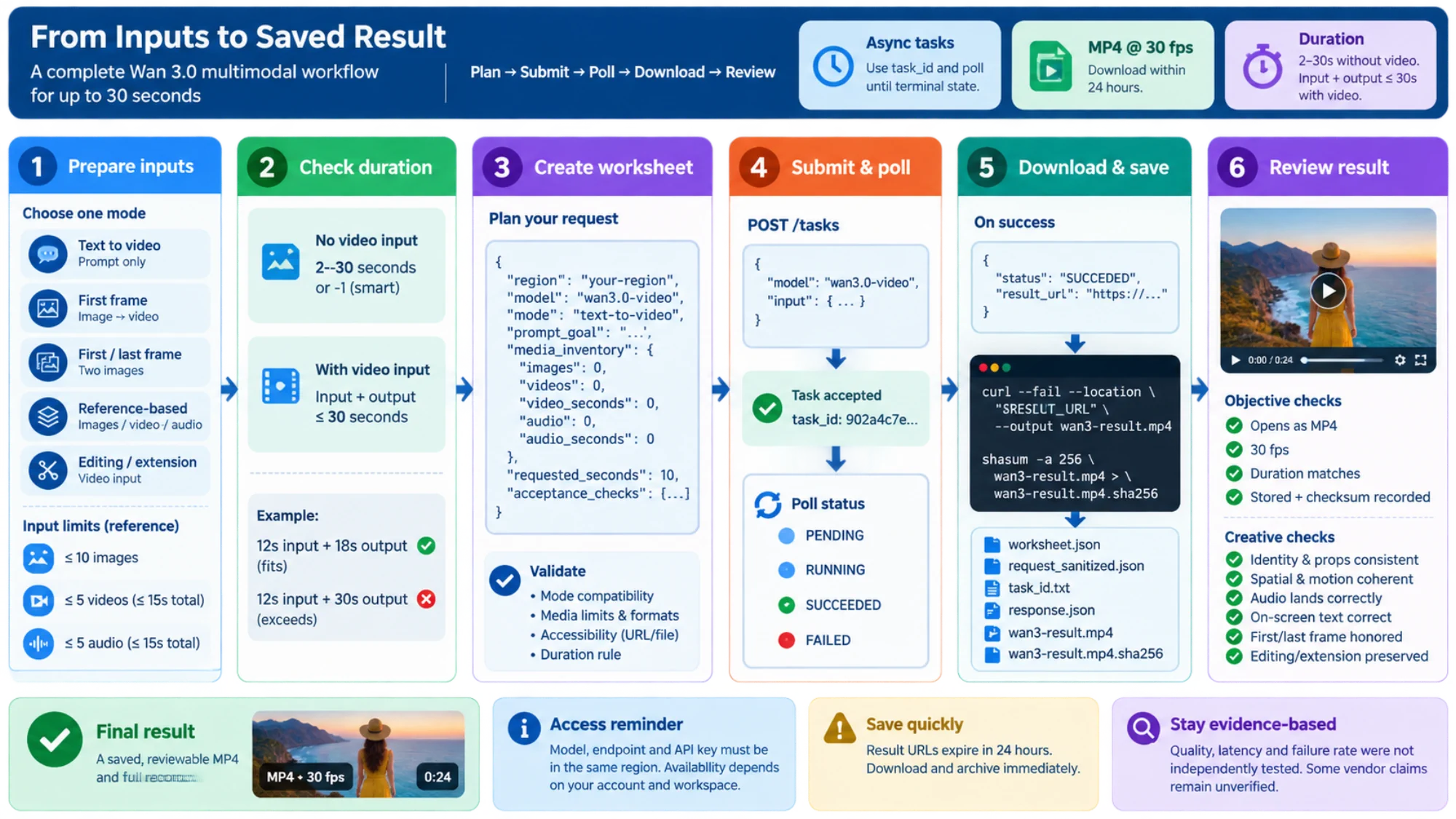
6. Review the output against the job, not the demo reel
Start with objective checks:
- the file opens as MP4;
- reported frame rate is 30 fps;
- actual duration matches the accepted request;
- the file is durably stored and its checksum is recorded.
Then review the creative failure modes that matter to the job:
- Does the same person, product, or prop remain identifiable across cuts?
- Do spatial relationships and motion direction remain coherent?
- Does speech or sound land on the intended action?
- Is on-screen text spelled and timed correctly?
- If a first or last frame was supplied, does the output honor it closely enough?
- Did editing or extension preserve the portions that were meant to remain stable?
Do not waive these checks because a showcase looked strong. Real-world 30-second quality, latency, and failure rate were not independently measured for this article, and Alibaba itself notes room for improvement in audio texture and on-screen text accuracy.
Hosted or local: the decision rule
Use the official hosted route when you can accept region-bound service access, asynchronous jobs, and a temporary result URL—and when your data policy permits uploading the inputs. It is the only first-party Wan 3.0 execution path established by the evidence reviewed here.
Do not plan a Wan 3.0 local deployment until first-party code, weights, a weight-applicable license, dependencies, hardware requirements, and a reproducible inference path are all available. A README, a repository license, a similarly named older model, or a third-party download is not a substitute.
If neither path fits, pause the model decision. The cheapest failure to correct is an access assumption made before production assets, integration work, or security review depend on it.
Frequently asked questions
Is Wan 3.0 officially released?
It is officially documented as a hosted Model Studio service, but Alibaba's public pages disagree on whether the rollout label is preview or generally available. Verify the model in your own region and account rather than relying on a universal release label.
Is Wan 3.0 under Apache 2.0?
The public AlibabaCloud-Official/Wan3.0 repository contains an Apache 2.0 license. That license covers the work distributed in that repository under its terms. At the check date, the repository did not contain model weights or inference code, so the license file is not evidence that absent weights were released under Apache 2.0. This is a practical artifact distinction, not legal advice.
Can Wan 3.0 generate a full 30-second video?
The API reference permits an output duration up to 30 seconds when there is no video input. When video input is present, input and output durations must total no more than 30 seconds. The default is 5 seconds, and -1 requests smart duration.
Does Wan 3.0 accept 20 reference files?
Alibaba promotes support for up to 20 multimodal reference assets. The API reference separately documents limits of 10 images, 5 videos totaling up to 15 seconds, and 5 audio clips totaling up to 15 seconds. Mode-specific exclusions and media constraints still apply, so do not assume all 20 can be combined arbitrarily.
What should I preserve after a successful task?
Save the MP4 before its 24-hour URL expires, plus the sanitized request, task_id, terminal response, request worksheet, documentation check date, and checksum. That bundle lets another person understand what was submitted and verify which artifact was accepted.
The practical takeaway
Treat Wan 3.0 as an official hosted capability with a conditional 30-second duration—not as a confirmed local open-weight release. Verify access in your region, choose one supported mode, calculate the video-duration budget, validate media constraints, submit asynchronously, and archive the MP4 immediately. Then judge the result against explicit continuity, audio, text, and framing checks.
That process gives you something more useful than a launch claim: a request you can explain, a result you can preserve, and a clear boundary around what remains unknown.