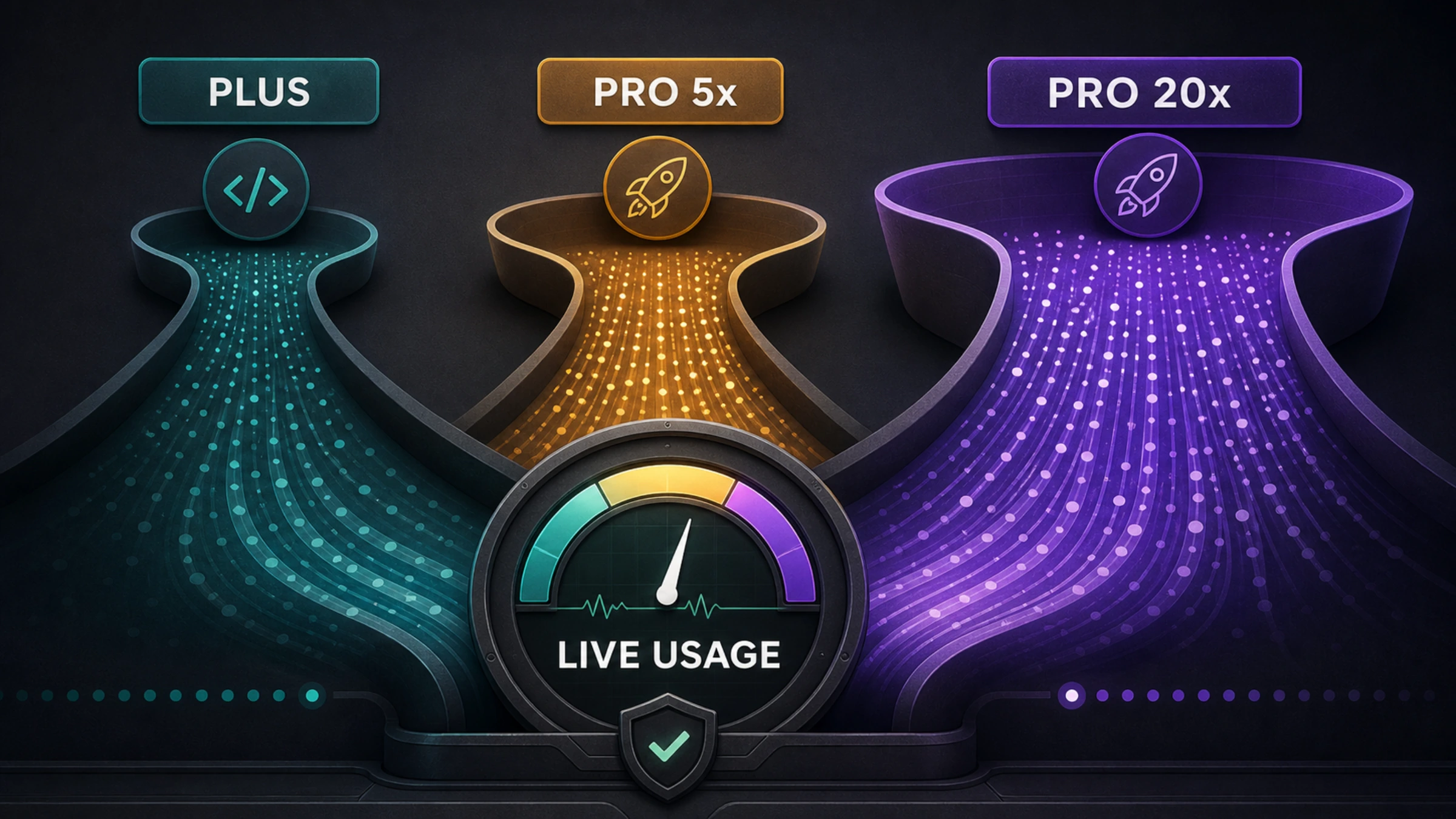
There is no single public, verified weekly token allowance for Codex on ChatGPT Plus, Pro 5x, or Pro 20x. Included usage varies with the model and the work you ask Codex to do. Local messages and cloud chats share a five-hour window, and additional weekly limits may apply.
The useful comparison is therefore capacity, not a made-up token total:
| Plan | Public US list price | Included Codex capacity | Best fit |
|---|---|---|---|
| Plus | $20/month | Baseline | Occasional or light daily coding work |
| Pro 5x | $100/month | 5× Plus usage | Regular professional use that repeatedly constrains Plus |
| Pro 20x | $200/month | 20× Plus usage | Sustained, Codex-heavy work that can justify the larger buffer |
Prices are the public USD list prices checked on August 21, 2026. Tax, billing currency, availability, and purchase eligibility can vary by region and account. The 5× and 20× figures describe relative Codex usage, not a guaranteed number of prompts, tasks, or tokens.
Before changing plans, open your Codex usage dashboard. In an active Codex CLI session, run:
text/status
Use the allowance and reset information shown for your account as the operational source of truth.
Why “tokens per week” is the wrong unit for included usage
Token counts do matter in some Codex billing contexts, but they do not translate into one fixed subscription allowance.
Consumption can change with:
- the model;
- task size and complexity;
- the amount of context Codex must inspect;
- local versus cloud execution;
- reasoning, tool use, and retrieval;
- how much input can be served from cache;
- the amount of output produced.
A short request that triggers repository exploration, tests, and several tool calls may consume more allowance than a longer prompt that needs a small, isolated edit. Two tasks that look similar in chat can also have different costs because their context and execution paths differ.
This is why forum conversions such as “one plan equals X million tokens per week” are not reliable plan-selection rules. They may describe one person's workload, model mix, or account at one moment. They do not establish the allowance on your account.
The four usage layers people commonly mix together
1. Included ChatGPT plan usage
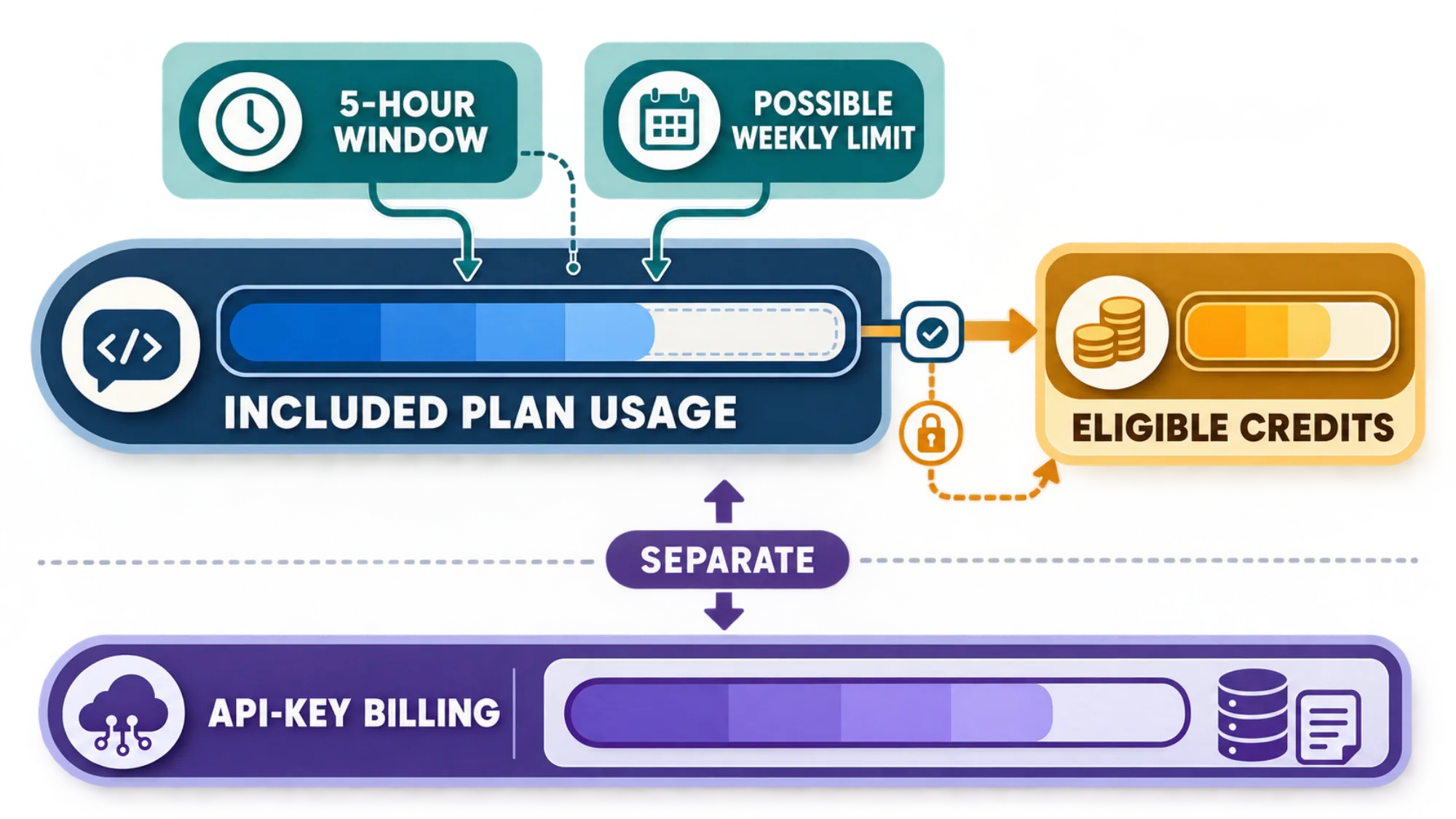
Plus and Pro include Codex usage. The current public plan comparison describes Pro as two capacity tiers—5× and 20× Plus—and says local messages and cloud chats share a five-hour window. It also warns that additional weekly limits may apply.
The public material does not establish one universal weekly reset anchor or a fixed token-to-allowance conversion. If your account displays a reset time, follow that account-specific label.
2. The five-hour window
This is a shared rolling constraint for local messages and cloud chats, not a promise that every five-hour period contains a fixed number of identical tasks. Variable task consumption still applies.
The practical question is: Does your normal work hit the five-hour constraint before you can finish a useful block of work? Record that interruption instead of trying to infer a token bucket.
3. Purchased credits
On eligible accounts, included plan usage is consumed before purchased credits. Credits can extend supported Codex usage after the included allowance is reached, but availability, pricing, auto-recharge, and supported features can vary by account and region.
Credit-based activity can be metered from input, cached-input, and output tokens at model-specific rates. That does not mean the included Plus or Pro allowance is itself a fixed token wallet.
4. API-key billing
Codex usage charged to an API key is separately usage-based. Do not add API token spend to a ChatGPT subscription meter and treat the sum as one weekly allowance. Keep the two cost paths separate when comparing plans.
How to measure the plan you actually need
Run a representative workload before you upgrade. A useful sample is several normal workdays rather than one unusually large task.
Track five things:
- Starting allowance. Note what the dashboard or
/statusshows before work. - Work completed. Record meaningful outcomes—bug fixed, tests added, refactor finished—not just prompt count.
- Workload characteristics. Note the model, repository size, context depth, local or cloud execution, and whether the task used tools or retrieval.
- Interruptions. Record when a five-hour or weekly constraint stops useful work and what remained unfinished.
- Displayed reset. Copy the reset information shown by your account instead of assuming that everyone resets on the same weekday or at midnight.
A compact log is enough:
| Day | Useful outcomes | Heavy context/tool work? | Limit interruption? | Reset shown |
|---|---|---|---|---|
| Mon | Fixed auth bug; added regression tests | Yes | No | Account display |
| Tue | Reviewed two small PRs | No | No | Account display |
| Wed | Large migration | Yes | Yes—work paused | Account display |
The exact numbers in your log are private to your account. The decision signal is whether constraints are recurring and material.
Plus vs Pro: a workload-based decision
Stay on Plus when the limit is not changing your output
Plus is the sensible starting point when Codex supports occasional fixes, code explanations, small reviews, or bounded feature work and you usually finish without a limit interruption.
Do not upgrade simply because the meter moves quickly during one complex task. Variable consumption means a single outlier is weak evidence. Look for a repeated pattern across normal work.
Consider Pro 5x when Plus repeatedly interrupts valuable work
Pro 5x is the first capacity step when your representative log shows that Plus regularly stops normal coding sessions or forces you to postpone work. The relevant comparison is the value of uninterrupted work against the additional public list-price difference—not an assumed token price for included usage.
The 5× multiplier is relative capacity. It does not guarantee five times as many completed tickets because task mix can change.
Consider Pro 20x only for sustained Codex-heavy use
Pro 20x is designed for substantially heavier usage. It is easier to justify when Codex is a continuous part of multiple daily workflows and the 5× tier would still leave a recurring, costly constraint.
If you have not observed the 5× tier or cannot identify limit-driven interruptions in your current workload, the 20× tier is difficult to size responsibly. Start from evidence you can see, then reassess.
Consider credits when the problem is a temporary spike
If your account is eligible, credits may be a better match for a short-lived burst than a permanent plan change. Compare the account-visible credit option with the recurring cost of the next tier. Do not assume that credits are available, priced identically, or usable for the same features in every region.
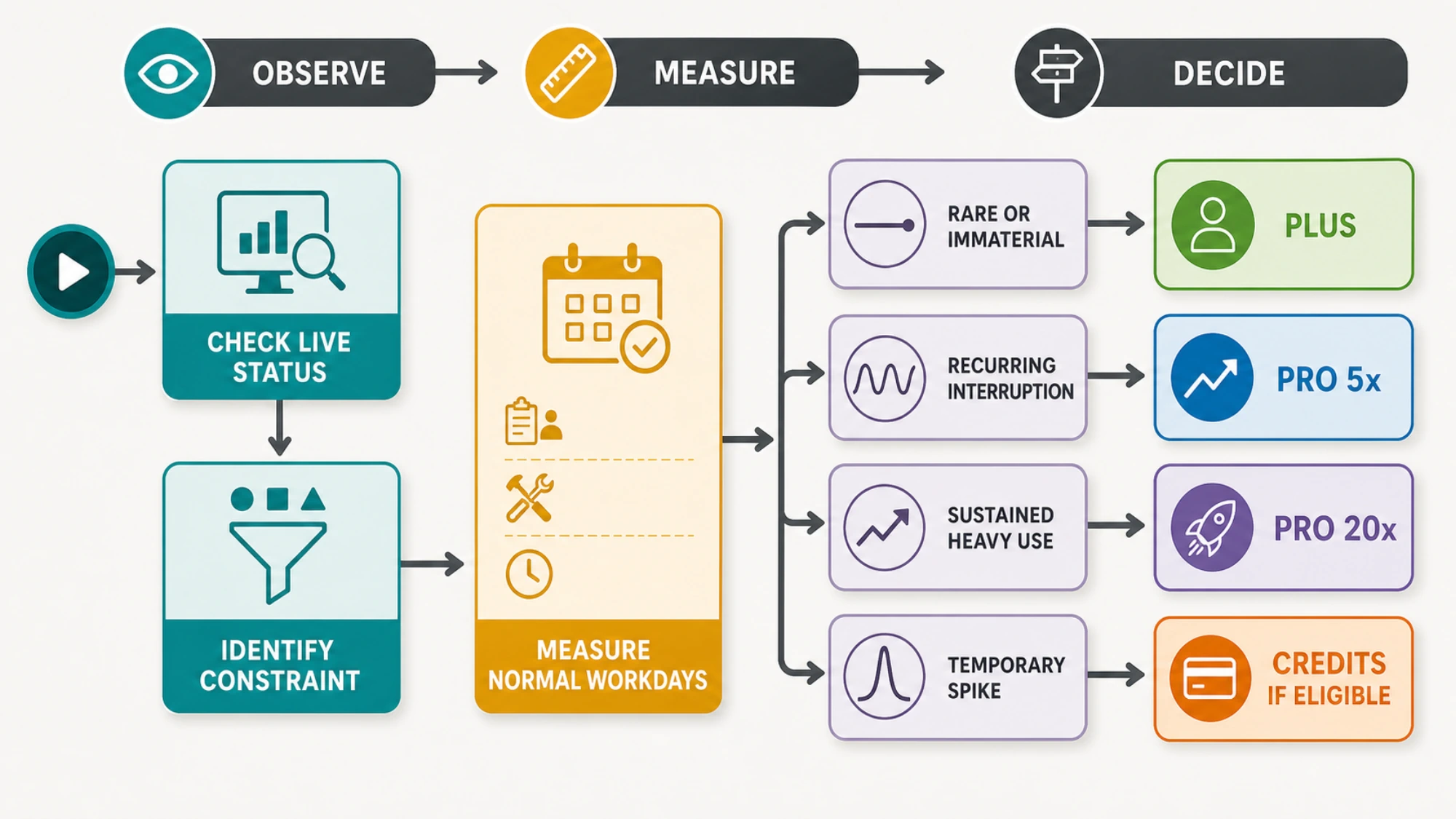
A simple decision rule
Use this sequence:
- Check the live dashboard or
/status. - Confirm whether the constraint shown is the five-hour window, an additional weekly limit, or exhausted included usage followed by a credit option.
- Measure several representative workdays.
- Stay on Plus if interruptions are rare or immaterial.
- Choose Pro 5x if Plus repeatedly blocks valuable normal work.
- Choose Pro 20x only if your measured workload clearly exceeds what the 5× tier can reasonably absorb.
- Use eligible credits for temporary overflow when that is more economical than recurring extra capacity.
This method cannot guarantee future capacity: models, product limits, account eligibility, and public pricing can change. It does give you a decision based on your real work rather than a stale community estimate.
Frequently asked questions
What is the weekly Codex token limit on ChatGPT Plus?
No universal exact weekly token allowance for Plus is published in the current public first-party material checked for this guide. Official pricing says usage varies, local messages and cloud chats share a five-hour window, and additional weekly limits may apply. Check your dashboard or /status for the limits and reset information currently shown to your account.
Does ChatGPT Pro give unlimited Codex usage?
No. The public comparison describes Pro as 5× or 20× the Codex usage of Plus. It also describes a shared five-hour window and possible additional weekly limits. “20×” is a relative capacity tier, not “unlimited.”
Does Pro 5x mean five times as many prompts?
Not necessarily. Usage varies with the model, context, task complexity, execution path, tools, retrieval, caching, and output. Five times the included usage does not guarantee five times the prompt count or completed work.
When does the weekly limit reset?
There is no universal ordinary weekly reset anchor confirmed by the public pages used here. Use the reset label displayed in your account. Do not assume another user's weekday, time zone, or countdown applies to you.
Are purchased credits part of my weekly token limit?
No. For eligible accounts, included plan usage is used first and purchased credits can extend supported usage afterward. Credit-based metering can use model-specific input, cached-input, and output token rates, but that is separate from a fixed included weekly token bucket.
Is API usage included in Plus or Pro?
API-key usage is separately usage-based and should not be conflated with included ChatGPT subscription usage. Track API costs and ChatGPT plan capacity as separate budgets.
Check the live sources before you buy
Limits and prices can change. Confirm the current details on OpenAI's Codex pricing page, review how Codex works with your ChatGPT plan, and use your signed-in usage dashboard or /status for account-specific values.
The shortest defensible answer is: Plus is the baseline, Pro offers 5× or 20× more Codex usage, and your own meter—not a universal weekly token number—should decide whether you upgrade.