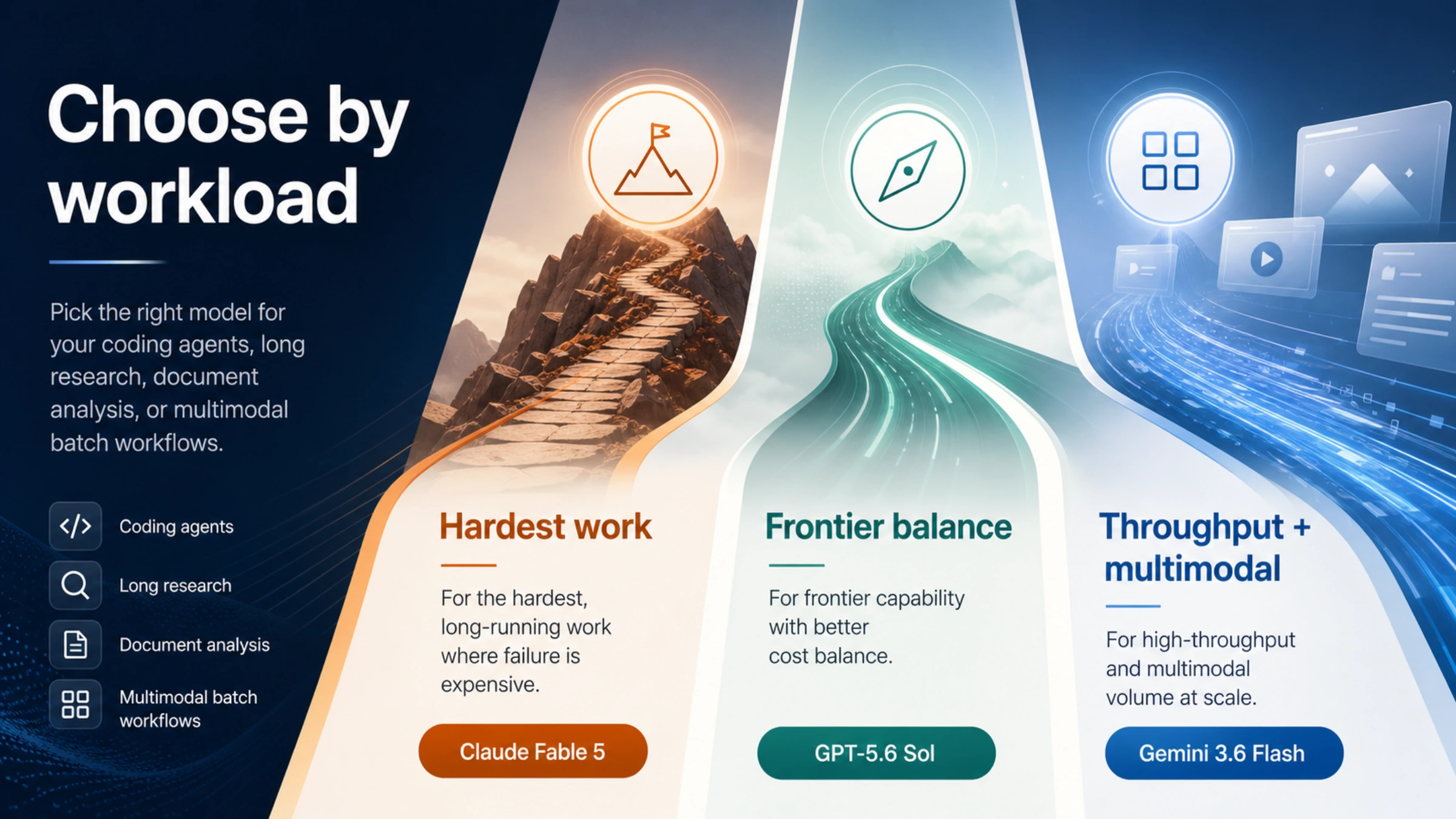
The useful answer is conditional:
- Start with Claude Fable 5 when the task is unusually hard, long-running, and expensive to get wrong.
- Start with GPT-5.6 Sol when you want frontier capability without paying Fable's full premium on every attempt.
- Start with Gemini 3.6 Flash when throughput, multimodal inputs, and unit economics matter more than the last few points on a composite benchmark.
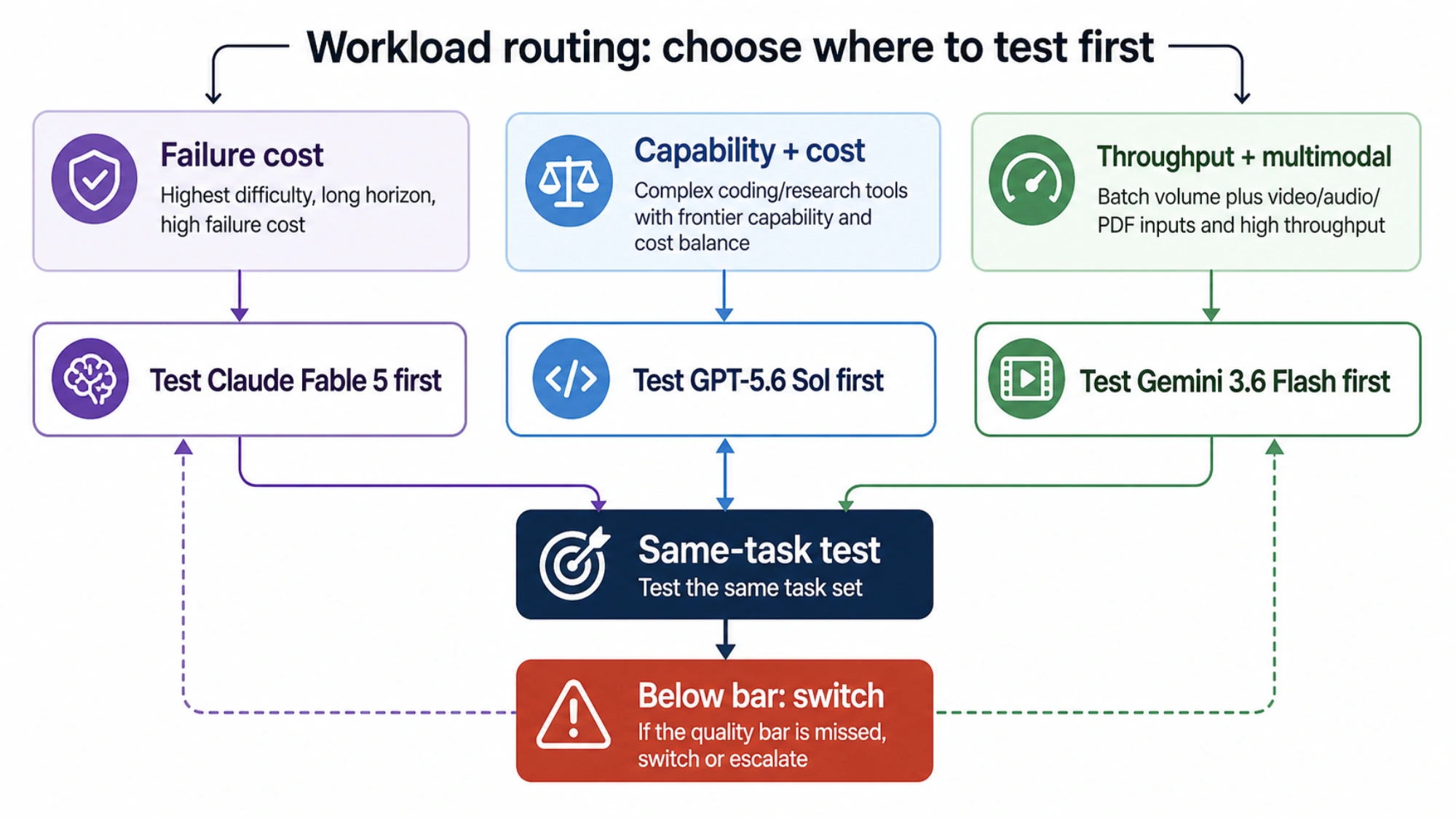
That is a test order, not a permanent ranking. The winner for your system is the least expensive model that reliably clears your acceptance threshold under the same tools, time limit, and failure policy.
Compare the products before comparing the scores
As of August 7, 2026, all three offer roughly a million tokens of context. They do not offer the same output ceiling, input modalities, reasoning controls, or failure behavior.
| Decision input | GPT-5.6 Sol | Claude Fable 5 | Gemini 3.6 Flash |
|---|---|---|---|
| Official API identifier | gpt-5.6-sol; gpt-5.6 is an alias | claude-fable-5 | gemini-3.6-flash |
| Base input / output price | $5 / $30 per 1M tokens | $10 / $50 per 1M tokens | $1.50 / $7.50 per 1M tokens |
| Context window | 1,050,000 | 1,000,000 | 1,048,576 |
| Maximum output | 128,000 | 128,000 | 65,536 |
| Input modalities listed on the model page | Text, image | Text, image | Text, image, video, audio, PDF |
| Reasoning behavior | Configurable effort | Adaptive thinking is always on; depth via effort | Thinking supported; medium by default |
| Integration edge case | Long prompts can trigger higher rates | A classifier refusal can be HTTP 200 | Thinking is included in output billing; tools may add charges |
These are first-party API facts from OpenAI's Sol model page, Anthropic's model overview, the Fable 5 integration guide, and Google's Gemini 3.6 Flash model page. The modality row uses model-page terminology. Claude separately accepts PDF document blocks, while Responses API file tools and other provider features belong to the API workflow layer rather than that row. These are not ChatGPT, Claude.ai, or Gemini subscription prices. Taxes, marketplace rates, priority processing, batch discounts, caching, and tool charges can change the bill.
A million-token window is also not a promise that a model will use every token well. Retrieval quality, instruction placement, tool transcripts, and output budget still determine whether the model finds the right evidence and completes the job.
Fable, Sol, and Flash buy different kinds of headroom
Fable 5 buys a higher ceiling for difficult long-horizon work
Anthropic positions Fable 5 for its hardest coding and knowledge-work projects. It supports a 1M context window, up to 128k output, and always-on adaptive thinking. That makes it a sensible first candidate for migrations across large codebases, multi-stage research, difficult document reasoning, and agents expected to keep checking their own work over long runs.
Its base price is also the highest: $10 per million input tokens and $50 per million output tokens. You should pay that premium when one missed requirement or failed run costs more than the model difference—not because a leaderboard moved by one point.
Fable has an important operational behavior. A safety-classifier refusal can arrive as HTTP 200 with stop_reason: "refusal". A client that equates HTTP success with task success will misclassify that response. Treat refusal as its own outcome, then decide whether to narrow the request, send it to human review, or use an allowed fallback.
Sol is a practical frontier candidate
GPT-5.6 Sol costs $5 per million input tokens and $30 per million output tokens. It accepts text and image input and supports a broad Responses API tool set, including web and file search, code interpreter, hosted shell, computer use, MCP, and tool search. Endpoint, account, and policy still govern actual availability.
That combination fits hard coding agents, professional analysis, tool-rich research, and document or spreadsheet delivery that must eventually scale. Sol is materially cheaper than Fable at base token rates while sitting close to it in current independent composite results. It is therefore a strong default candidate, not proof that it wins every hard task.
OpenAI applies a long-context multiplier when Sol input exceeds 272k tokens. Dumping an entire repository or archive into one prompt can raise cost while making the relevant evidence harder to retrieve. Trim and structure context before paying for a larger reasoning setting.
Gemini 3.6 Flash buys iterations, modalities, and volume
Gemini 3.6 Flash is $1.50 per million input tokens and $7.50 per million output tokens on the standard paid Gemini Developer API. It accepts text, images, video, audio, and PDFs, and returns text. Its supported tools include function calling, code execution, file search, URL context, Search and Maps grounding, structured output, and preview computer use.
That makes Flash a natural first test for media understanding, bulk document extraction, rapid agent loops, classification, and pipelines that escalate only difficult cases. Its maximum output is 65,536 tokens rather than 128k, so workflows expecting one very large deliverable need to account for that ceiling.
The right question is not whether Flash beats Fable on a general intelligence chart. It is whether Flash clears your quality bar fast enough and cheaply enough that buying unused capability would be wasteful.
Turn token price into cost per successful task
Suppose one attempt uses 100,000 input tokens and 20,000 output tokens. Ignoring caching, tools, retries, and special processing, the base calculation is:
textattempt cost = input_tokens / 1,000,000 × input_rate
             + output_tokens / 1,000,000 × output_rate
| Model | Calculation | Base attempt cost |
|---|---|---|
| GPT-5.6 Sol | 0.1 × $5 + 0.02 × $30 | $1.10 |
| Claude Fable 5 | 0.1 × $10 + 0.02 × $50 | $2.00 |
| Gemini 3.6 Flash | 0.1 × $1.50 + 0.02 × $7.50 | $0.30 |
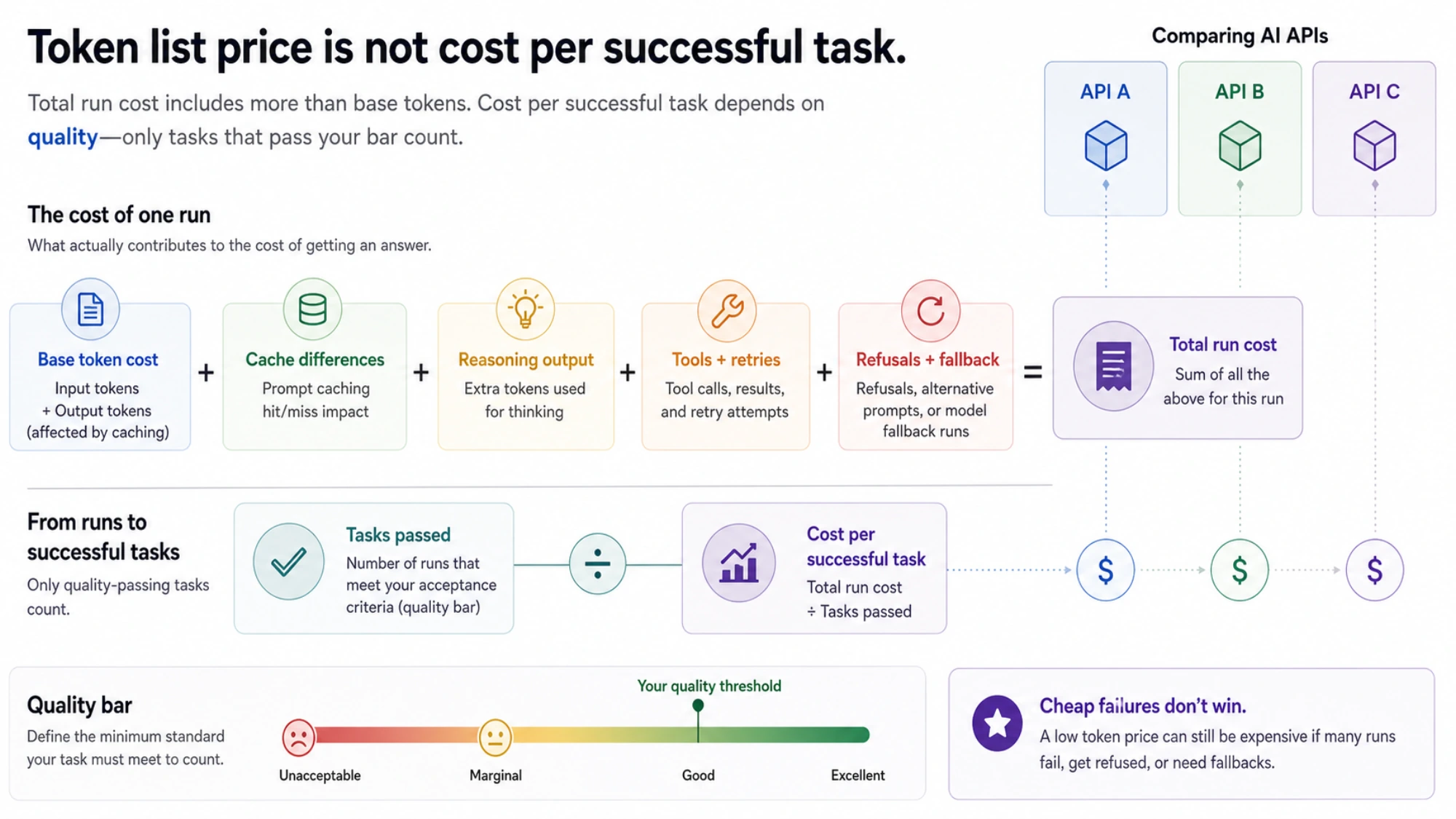
This only answers what equal token volumes cost at base list rates. A production comparison must include reasoning and generated tokens, cache writes and reads, tool charges, long-context or priority rates, timeouts, refusals, invalid outputs, retries, and human review.
Use this denominator instead:
textcost per successful task =
  (all model attempts + tool fees + review cost) / accepted tasks
If Flash needs four runs to produce one acceptable result while Sol passes once, $0.30 versus $1.10 is no longer a fourfold advantage. If both pass a structured extraction task on the first attempt, Flash's price and throughput advantages are real.
Read independent measurements without inventing a champion
Artificial Analysis's Fable 5 page, Sol page, and Gemini page reported Intelligence Index v4.1.1 scores of 62, 61, and 52 when checked on August 7, 2026. The configurations are not identical: Fable uses adaptive reasoning at maximum effort with an Opus 4.8 fallback; Sol uses max; Gemini uses high. This volatile snapshot puts Fable and Sol close on that composite and Flash in a different price/performance position. It does not predict which model will pass your repository tests.
The same pages showed output throughput of roughly 67 tokens/s for the tested Fable configuration, 62.9 for Sol max, and 219.2 for Gemini high. Output throughput begins after generation starts. It is not time to first token or end-to-end completion time with reasoning and tools. Reopen the specific model pages before a purchase or migration because these measurements change.
Quesma's Baba Is You experiment gives a useful warning about task economics. In its later-stage setup, Fable and Sol each solved 13 of 14 levels; Fable finished faster, while Sol cost less. Gemini 3.6 Flash was not tested, and the later experiment used model-specific harnesses. The result should not become a three-model ranking. It shows why harness, token use, completion rate, and task cost belong in the same record.
Provider launch charts have another limitation: they explain what the provider designed and measured, but the provider chose the prompts, settings, and comparison set. Use those charts to generate hypotheses, not to close procurement.
Run one fair acceptance test on your workload
You do not need a giant benchmark to make a better first decision. You need a small set that represents your actual failure modes.
- Choose 6–12 real tasks. Include routine work, one long-context case, and two or three cases that have failed before. Remove secrets and customer data.
- Write the acceptance rubric first. Tests must pass, unrelated files must remain untouched, citations must open, or JSON must validate. Do not change the rules after seeing a favorite output.
- Hold conditions constant. Give each model the same source material, tool permissions, deadline, and maximum budget. Record the exact model ID and reasoning setting.
- Repeat each task at least three times. One polished demo hides variance. Measure first-pass success, eventual success, and human interventions.
- Log the entire path. Separate input, output, reasoning, cache, tool calls, refusals, timeouts, retries, first-token latency, and end-to-end time.
- Decide among models that pass. Eliminate models below the quality threshold first; then compare cost per accepted task and turnaround time.
A useful stop rule is simple: if a model misses the first-pass threshold on high-risk tasks, a lower token price does not qualify it for production. If two models are within your meaningful quality margin, choose the one with lower successful-task cost and a failure mode your system can handle.
For medical, legal, financial, security, or other high-stakes work, a 6–12-task sample is only a pilot. Expand the dataset and add qualified human review.
A deployment choice is usually a routing policy
| Primary constraint | Test first | Why | Switch when |
|---|---|---|---|
| Very hard coding or long agents | Claude Fable 5 | Buy capability headroom where failure is expensive | Refusals, cost, or turnaround exceed your limit |
| Complex professional work at scale | GPT-5.6 Sol | Strong frontier/economics balance | Move routine volume to Flash or hardest misses to Fable |
| Video, audio, PDF, or rapid multimodal loops | Gemini 3.6 Flash | Broad inputs, throughput, and lower base price | Escalate only cases that miss the rubric |
| Bulk extraction and classification | Gemini 3.6 Flash | The quality bar may not require frontier spend | Compare Sol if retries erase the savings |
| Policy-sensitive workflows | Depends on your controls | Observable refusals and fallback matter more than a rank | Require explicit branches and human review |
Developers who want one OpenAI-compatible surface for an initial same-input trial can consult LaoZhang API's current model catalog, which lists all three IDs. Its documentation also says to confirm the live token group, region, price, and availability in the console. It is not a feature-identical substitute for the three official APIs; use official direct access when you need the provider's newest tools, native behavior, or service commitments.
The durable answer is often a two-tier route rather than one winner: run routine cases on the cheapest model that clears your bar, and escalate failed or high-risk cases to the stronger model. That policy remains useful after the next leaderboard update.