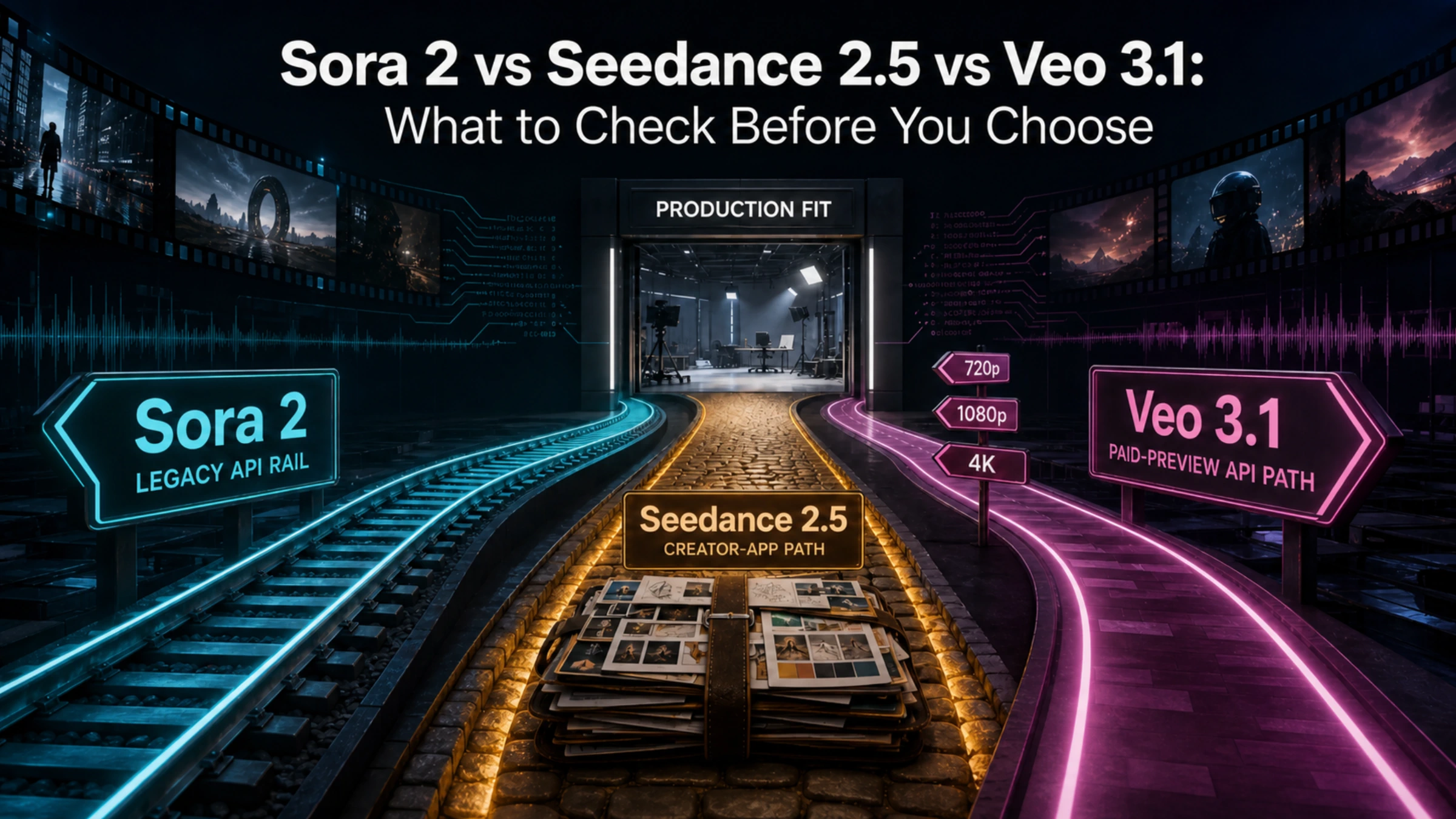
The practical answer is conditional:
- Start with Veo 3.1 when you need a documented paid API today, native audio, portrait or landscape output, and a clear ladder from 720p to 4K. Budget for preview change and choose Standard, Fast, or Lite deliberately.
- Start with Seedance 2.5 when the job is a longer, reference-heavy creative sequence: up to 30 seconds in one pass, many image/video/audio references, and targeted editing. Verify the actual surface first; ByteDance’s July 31 announcement still described official BytePlus API access as coming soon.
- Keep Sora 2 on the shortlist when you already have API access and its 720p output, synced audio, and $0.10-per-second list price fit. For a greenfield integration, its Legacy label is a material risk—not a footnote.
That is not a quality podium. No controlled same-prompt benchmark was run for this article. It is a way to avoid spending a test budget on a candidate that cannot meet the job before quality is even judged.
Before trusting any comparison, run an alias audit. sora-2 and Sora 2 Pro are separate catalog entries: the checked OpenAI page lists $0.10 per generated second for Sora 2 and $0.30 for Pro. A headline that tests Pro has not tested the exact Sora 2 route in this query. The same applies when a Seedance 2.0 score is presented as evidence for 2.5. Save the model selector, request ID/model field, raw response, and billing label; if those four records do not agree, treat the result as provider-specific rather than model-level evidence.
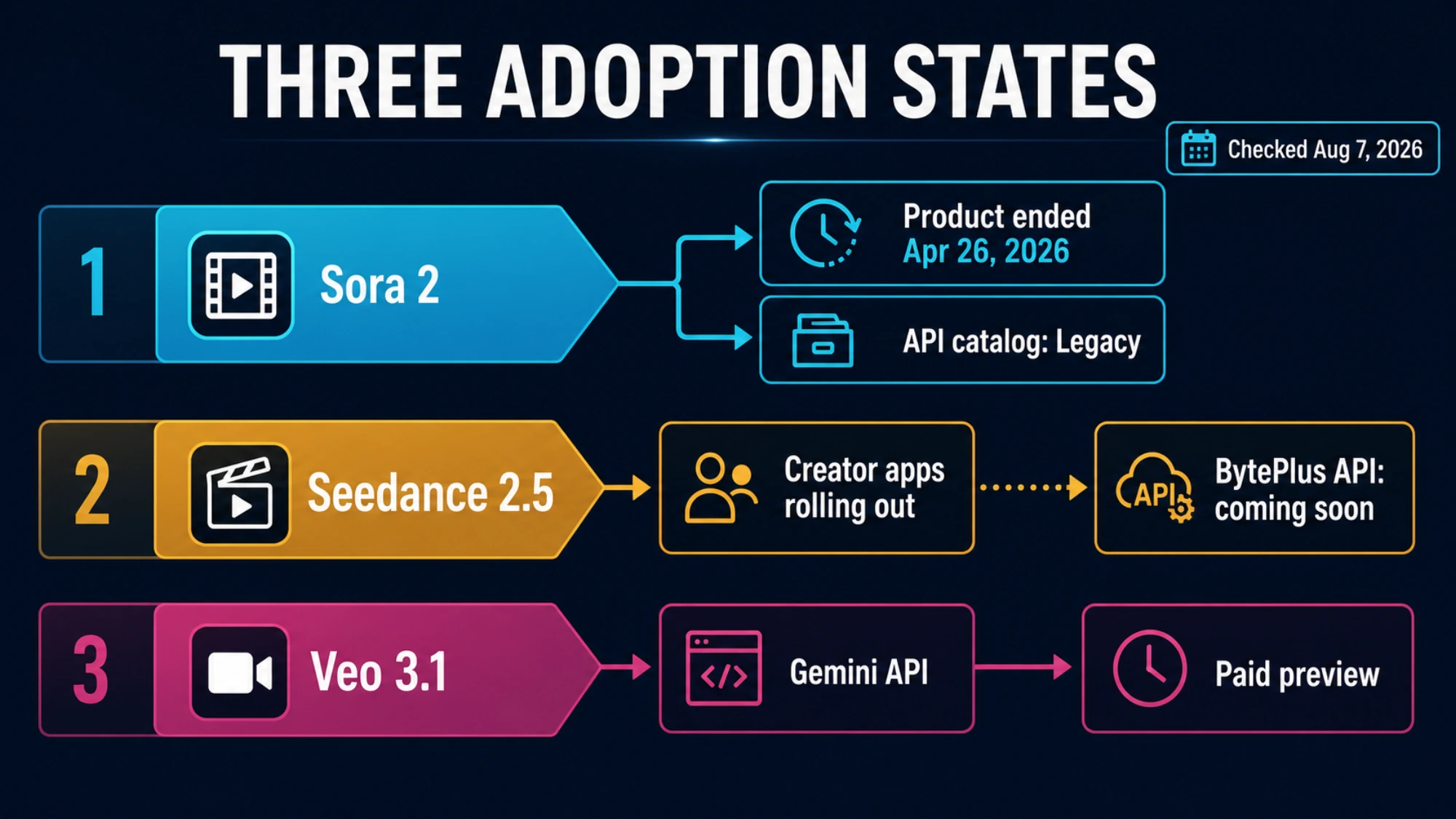
The names hide three different adoption states
The most important comparison is easy to miss because all three products can be described as audio-video generators.
OpenAI’s model catalog still exposes sora-2 through v1/videos, but labels it Legacy. The catalog documents text or image input, synced audio, 720x1280 or 1280x720 output, and a $0.10 price per generated second. Free tier is unsupported. Separately, the Sora 2 launch page now says the Sora product ceased to be available on April 26, 2026.
Those facts are not contradictory. A product surface can close while an API model remains listed. They do, however, change the adoption question: existing users should evaluate migration cost; new users should demand a lifecycle plan.
ByteDance launched Seedance 2.5 on July 31, 2026, with rollout in Jimeng AI, Doubao Pro, and other platforms. The same announcement said BytePlus ModelArk API access was coming soon. An app selector is evidence that you can try a creative workflow; it is not evidence that your backend can call a generally available first-party API.
Google’s Gemini API guide lists Veo 3.1 Standard, Fast, and Lite as paid preview models. That is the clearest new-integration path of the three in the checked sources, but “preview” means version stability and regression testing belong in the design.
Match the model to one of three production briefs
Brief A: a product clip that must ship in 4K
If native 4K is a hard requirement, Veo 3.1 Standard or Fast is the documented candidate. The Gemini API guide supports 720p, 1080p, and 4K; Lite stops at 1080p. Sora 2’s current API catalog lists only 720p portrait and landscape. Seedance 2.5’s announcement emphasizes story length and creative control rather than a public API resolution-and-price matrix.
For this brief, do not begin with “which model has the most cinematic demo?” Begin with the required delivery resolution, aspect ratio, audio, and deadline. A model that needs an external upscale may still win, but the upscale becomes part of cost and acceptance criteria.
Brief B: a 30-second multi-character story with revisions
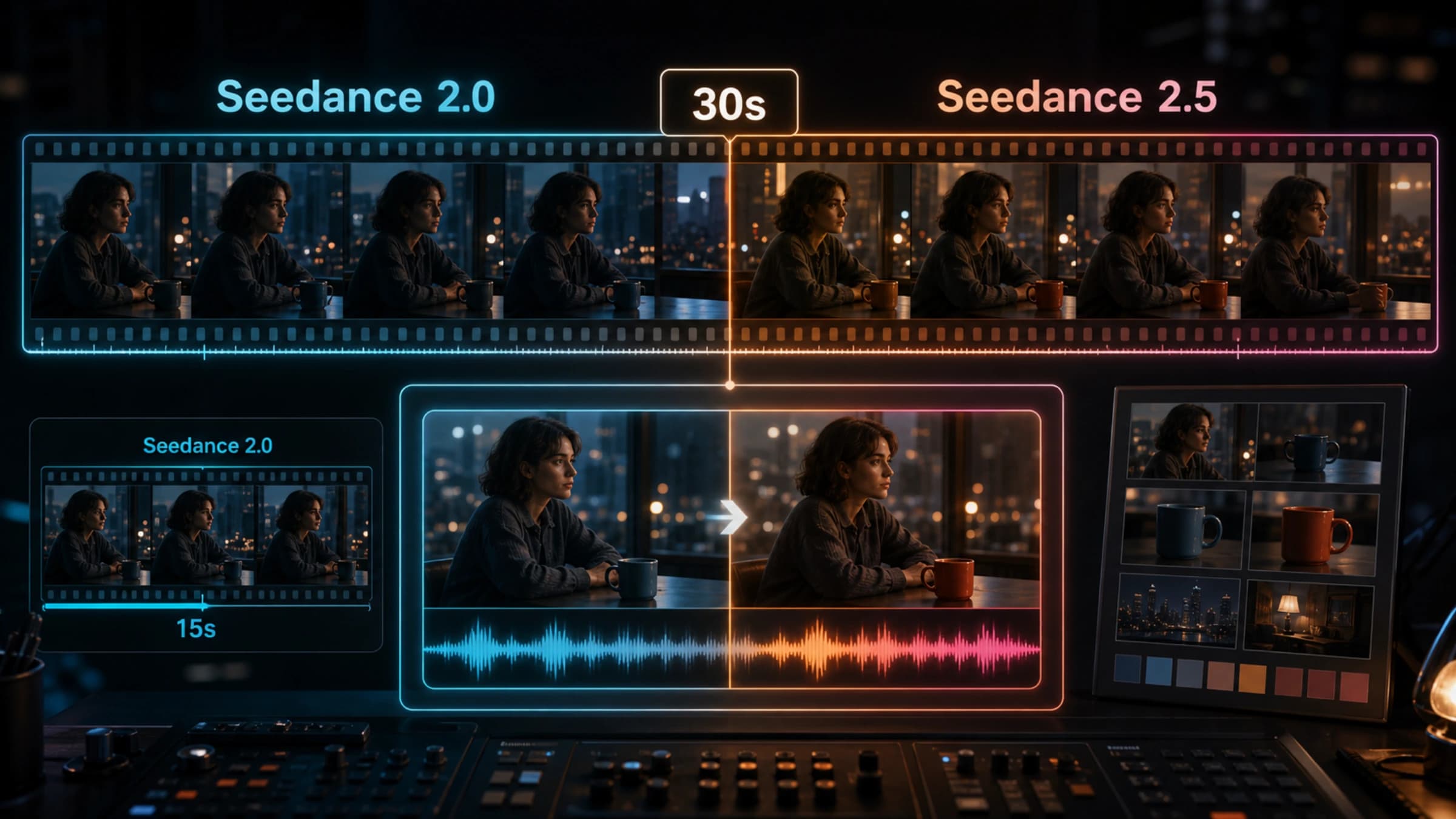
Seedance 2.5 is documented for up to 30 seconds of audio-video in one generation, multi-round extension, as many as 30 images, 10 video clips, and 10 audio clips in one reference package. Its launch material also describes timestamp-level changes, green-screen work, camera-perspective edits, and reference-based editing.
That is a different creative proposition from Veo’s up-to-three subject reference images or Sora 2’s documented text/image input. It is especially relevant when the expensive part is not the first render but preserving a cast, props, locations, and sound direction through revisions.
The caveat belongs next to the benefit: ByteDance also acknowledges remaining problems with complex-motion physics and multi-subject interactions. Thirty seconds of output is not automatically thirty seconds of usable continuity.
Brief C: an existing 720p API workflow that needs low disruption
Sora 2 can be rational when it is already inside the stack. Its published $0.10-per-second price is easy to model, output includes audio, and an existing integration may be more valuable than a feature upgrade that forces new policy, storage, retry, and monitoring work.
The decision changes for greenfield work. A Legacy dependency needs an exit trigger: an announced shutdown, a required feature the model cannot supply, or a successful-output cost above the replacement threshold.
Compare price only after you name the exact tier
The Gemini Developer API price sheet makes “Veo 3.1 price” an incomplete phrase:
| Gemini API model | 720p | 1080p | 4K |
|---|---|---|---|
| Veo 3.1 Standard with audio | $0.40/s | $0.40/s | $0.60/s |
| Veo 3.1 Fast with audio | $0.10/s | $0.12/s | $0.30/s |
| Veo 3.1 Lite with audio | $0.05/s | $0.08/s | Not supported |
For an eight-second 1080p generation, the list-price starting points are $3.20, $0.96, and $0.64. They are not finished-video costs.
The same Google price page adds an important billing boundary: audio processing can prevent a video from being generated, and the Gemini API charge applies only when a video is successfully generated. That narrows one billing unknown for this route; it does not erase waiting, rerun, review, or third-party-host costs.
Sora 2 would be $0.80 for eight generated seconds at its documented 720p size. The checked first-party Seedance 2.5 launch material does not publish a generally available official API price, so a reseller quote should not be placed in the same table as if it were ByteDance list price.
Use this instead:
accepted output cost = billed generations + operator wait/retry time + review and post-production
A $0.05 second that needs four reruns can lose to a $0.40 second that passes on the first attempt even when failed operations are not billed. Log three states separately: operation failed, video generated but rejected, and clip accepted.
Run a test that can change the decision
A generic “cinematic woman walking in Tokyo” prompt creates attractive reels but weak procurement evidence. Test one representative job and one failure-prone edge case.
Record these fields for every candidate you can access:
- exact model ID, product surface, region/account, date, resolution, and duration;
- prompt and reference assets, including what each reference is supposed to control;
- completion time, failed operations, policy rejections, and retries;
- adherence to shot order, identity, product details, camera direction, and audio timing;
- the edit work required to reach the same acceptance bar;
- total cost per accepted clip, not cost per attempt.
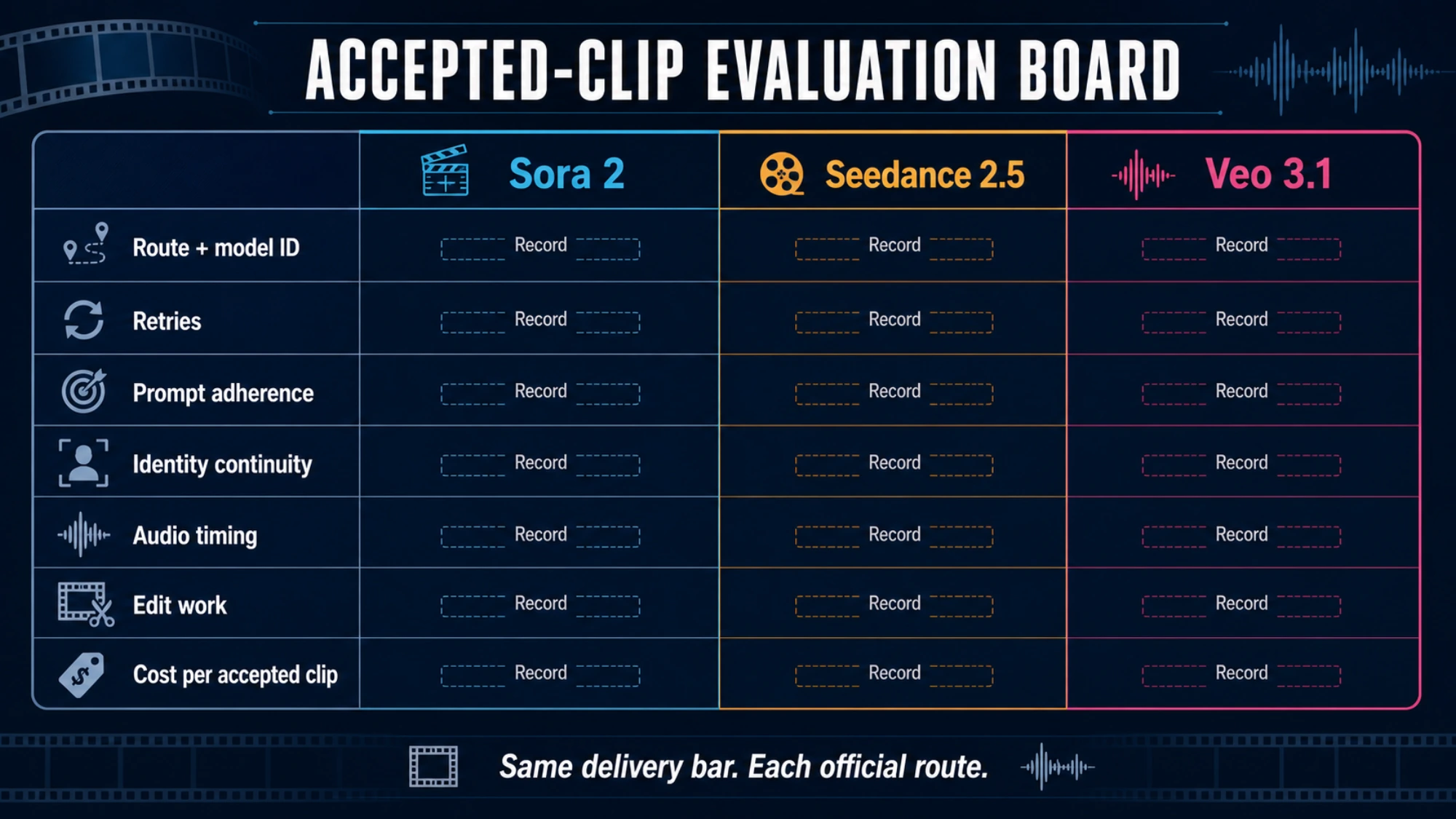
Do not force identical inputs into unsupported fields to manufacture “fairness.” First use each model through its documented route. Then compare whether each route can deliver the same business outcome.
A defensible shortlist for August 2026
For a new API-backed product, Veo 3.1 is the easiest first candidate to scope from public documentation. Model IDs, preview status, controls, resolution tiers, and list prices are current and explicit. The stopping condition is preview instability or a successful-output cost that misses the product margin.
For a creator working interactively with a dense reference package, Seedance 2.5 has the most distinctive documented workflow. The stopping condition is simple: if your actual account lacks the required 2.5 features or a production API you need, do not substitute a third-party label for first-party access without retesting the whole path.
For an established OpenAI video integration, Sora 2 may still be the lowest-change option. Treat Legacy as a trigger for migration rehearsal, not an immediate claim that the API is gone.
The model earns a production trial only after it passes your non-negotiable constraint. The winner is the route that produces an accepted clip at an acceptable total cost—and leaves you with a credible way out when the route changes.