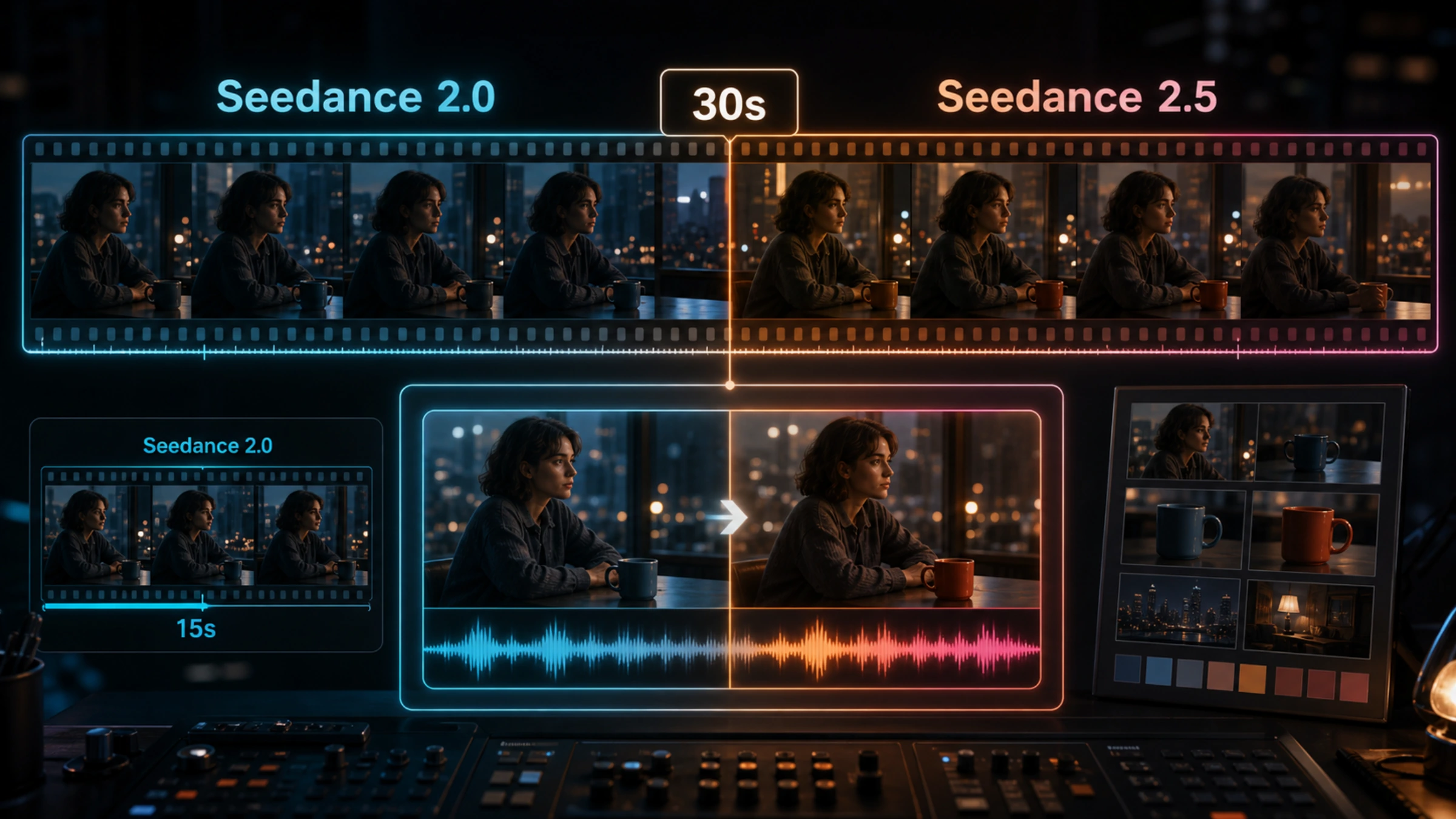
Seedance 2.5 has an easy marketing story: it can generate 30 seconds, twice Seedance 2.0’s published maximum. The more consequential production story is different. 2.5 can carry a larger creative brief into one generation and offers more specific ways to change an existing result.
That distinction matters because Seedance 2.0 already generated native audio and video, accepted mixed references, extended clips, and supported editing. The upgrade is not “video now has sound” or “editing finally exists.” It is a larger working canvas: 30 images, 10 videos, 10 audio files, longer continuity, and controls aimed at timestamps, perspective, green screen, motion, and reference-based revision.
Here is what those numbers mean when a real brief reaches production—and where the launch story stops short of a deployment decision.
Follow one 30-second brief through both versions
Imagine a product film with four beats: a runner enters an apartment, places a smartwatch on its charger, checks a recovery score, and leaves as the music resolves. The approved package includes the actor, wardrobe, watch from multiple angles, apartment, storyboard, running motion, interface reference, voice line, room tone, and music direction.
This is not a benchmark designed to crown a model. It is useful because it exposes three ordinary costs: a cut that breaks continuity, a reference that must be omitted, and a small error that forces a large regeneration.
In 2.0, the brief must fit a 15-second container
The official Seedance 2.0 launch lists up to 15 seconds and a reference allowance of nine images, three videos, and three audio files. That is already a capable multimodal package. For a short social hook or one concentrated action, it may be all the production needs.
For the four-beat film, the team must compress the scene or divide it. A division creates another boundary at which the actor, watch, room, movement, lighting, or sound can change. The problem is not merely the labor of stitching two files. It is that two independently generated clips have to agree about a world.
In 2.5, more of the brief can remain one problem
The official Seedance 2.5 announcement lists 30 seconds and up to 30 images, 10 videos, and 10 audio files. That allows the cast, product truth, space, shot plan, motion, interface, and sound direction to coexist without treating every reference slot as interchangeable.
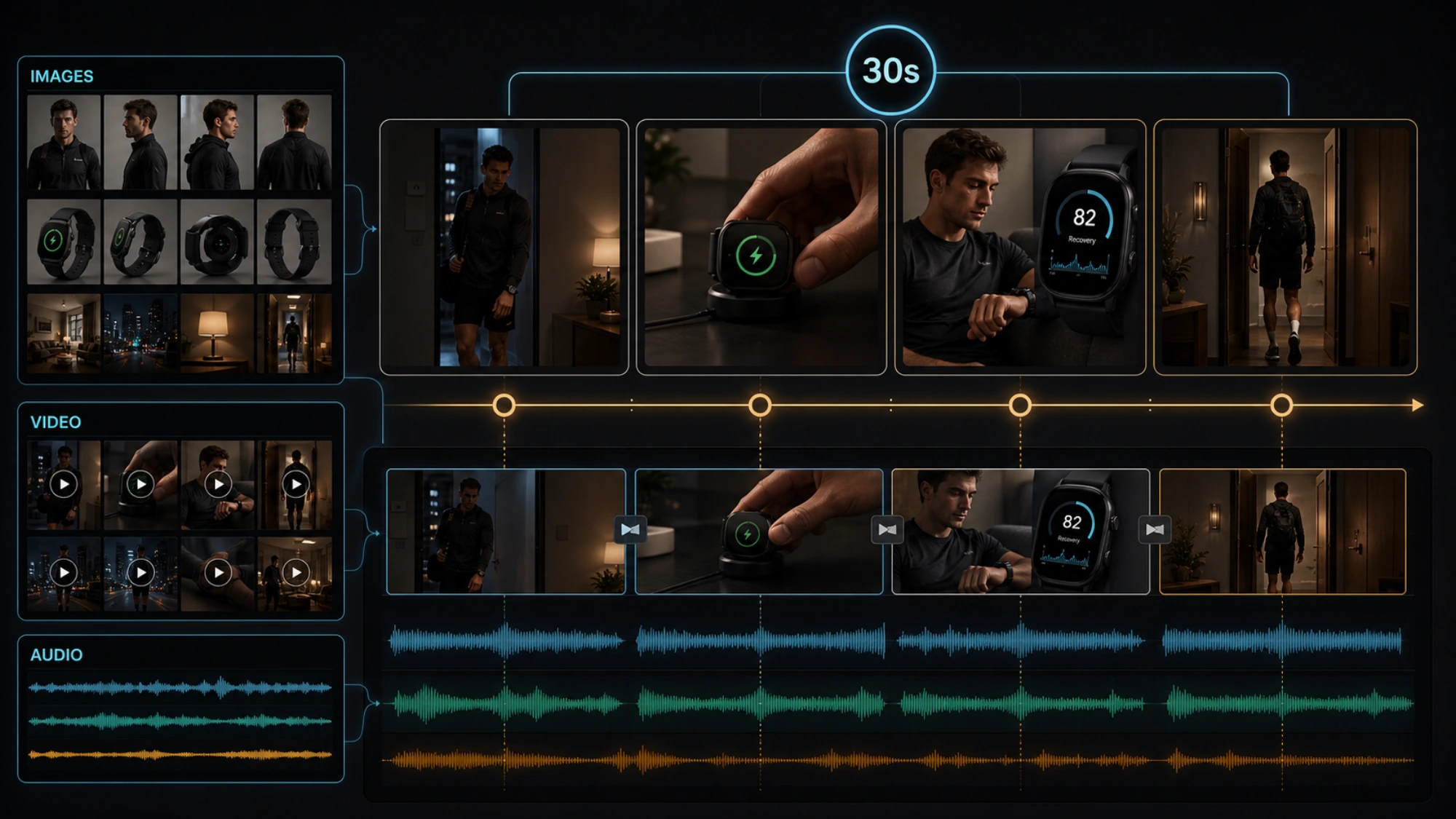
The larger allowance is useful only when every asset has a job. Conflicting wardrobe photos or two incompatible lighting references can reduce control even when the model accepts them. A good package identifies which files define identity and product facts, which define space and action, and which are merely stylistic.
Thirty seconds also expands the failure window. Identity, object geometry, causality, motion, and audio can drift late in a clip. ByteDance notes that physical plausibility in complex movement and stability with many interacting subjects still have room to improve. A longer maximum is therefore a continuity opportunity, not a quality guarantee.
The editing change can be worth more than the extra 15 seconds
Suppose the result is usable except for the smartwatch display between seconds 18 and 21. The expensive response is to regenerate the entire film and hope the actor, product, pacing, and sound remain acceptable. The valuable response is to identify that interval, replace the display, and preserve everything else.
Seedance 2.0 already offered extension and targeted editing. Seedance 2.5 emphasizes timestamp control and stronger workflows for green screen, camera perspective, clay renders and motion, and editing from references. The practical upgrade is not an abstract “more editability.” It is the possibility of narrowing the blast radius of a correction.
A revision succeeds only if both conditions hold:
- the requested element changes correctly;
- unrequested elements—face, wardrobe, product shape, light direction, action, framing, and audio timing—remain stable.
An edit that fixes the display but changes the watch case or the actor’s face has merely moved the defect. For many teams, preservation outside the edit region will be a more revealing measure than the beauty of the first generation.
Three claims that should not be credited to 2.5
“Seedance has native audio now”
Seedance 2.0 was already built around joint audio-video generation, including dialogue, music, ambience, and narration. Audio is part of the lineage, not a capability that began with 2.5.
“Editing is new”
Extension and editing already existed. What changed is the published scale and specificity of the workflow. Describing the difference as “no editing versus editing” makes 2.0 artificially weak and prevents readers from seeing what needs to be tested: control and preservation.
“Newer means cheaper, faster, or better looking”
Launch specifications do not establish any of those outcomes. Curated demos establish that a result can occur; they do not reveal retry rate, moderation failures, review time, latency, or how often a team gets an acceptable result from its own assets.
The same caution applies to resolution. A visible product plan, an API contract, and a third-party wrapper can expose different options. The public BytePlus 2.0 page inspected on Aug. 7, 2026 even showed 4K in plan cards while its FAQ named 1080P as the maximum. The downloaded file—not the largest number on a page—is the final evidence.
The release and the callable route are separate facts
ByteDance launched Seedance 2.5 on July 31, 2026. Its announcement said rollout was beginning in Jimeng AI and Doubao Pro, while ModelArk API availability was coming soon. In this research pass on Aug. 7, the visible BytePlus Seedance page still centered on 2.0 and 2.0 mini.
That observation does not prove that no account or provider has 2.5. It proves that four layers must not be collapsed:
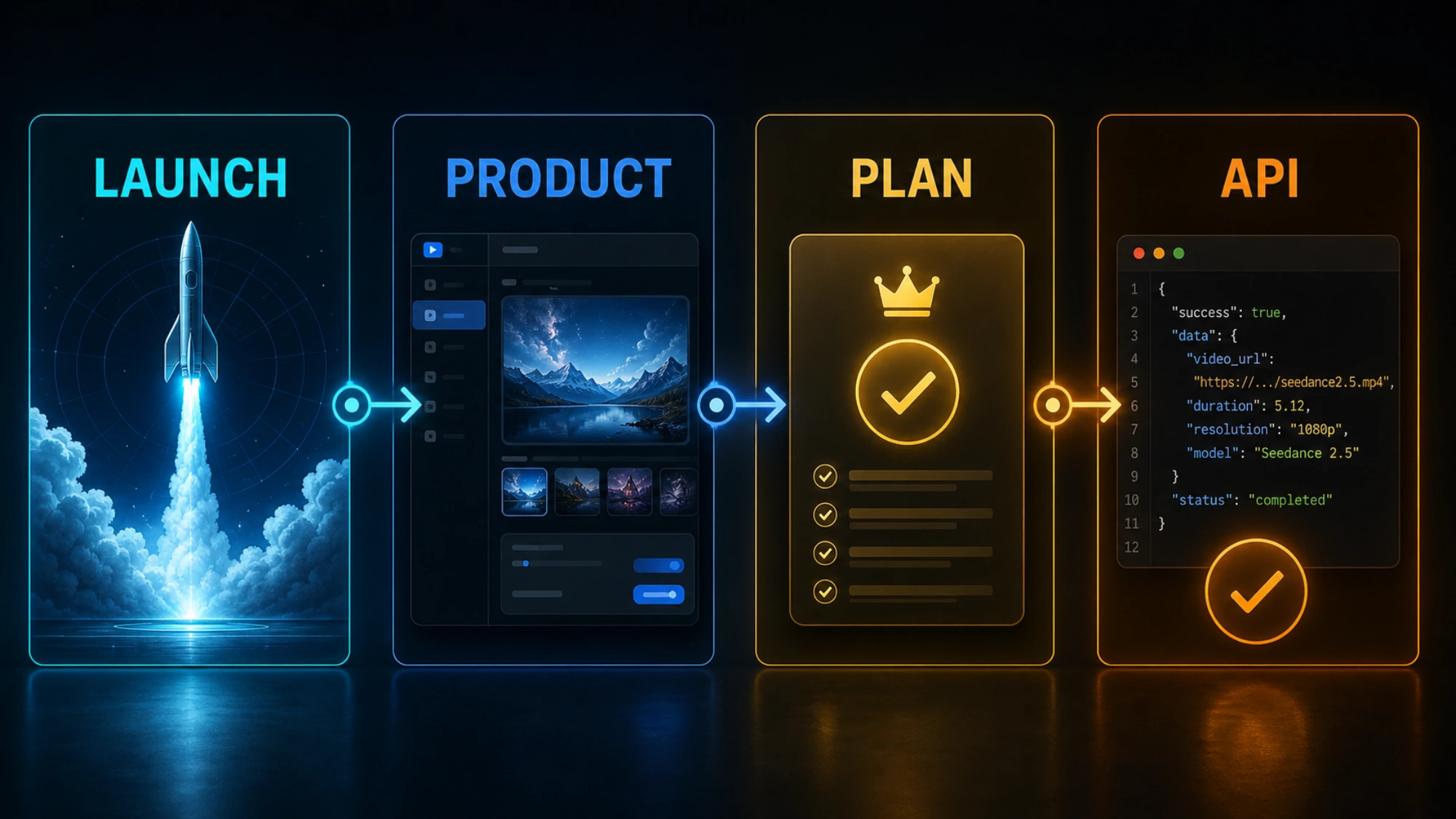
- Launch: the capability is publicly announced.
- Product access: the model appears in a specific interface and account.
- Plan access: the desired duration, references, resolution, and price are enabled.
- Callable access: the documented model ID, request fields, task lifecycle, and response work on the intended API.
Before changing an integration, confirm the exact model identity, accepted input formats, selectable output settings, asynchronous task states, result expiry, retry rules, failed-task billing, rate limits, region, and moderation behavior. A screenshot from a product interface cannot answer those API questions.
The meaningful comparison is the bottleneck that disappears
Return to the smartwatch film. Seedance 2.5 creates value if it removes one of three costs that Seedance 2.0 leaves visible:
- the 15-second seam no longer breaks the story;
- the full reference package fits without discarding protected product or character information;
- the display can be corrected without rebuilding the accepted parts of the film.
If the job is an eight-second social hook with four images and no revision, none of those advantages may be active. A working 2.0 route can be more useful than a larger 2.5 ceiling that the job never touches—or an API route that the team cannot yet call.
This is the cleanest Seedance 2.5 vs 2.0 conclusion: 30 seconds earns attention, but editing scope and reference capacity determine whether the upgrade changes production. Verify the actual route, then use one failed real-world brief to find out whether 2.5 removes a cost you already pay. That answer is more durable than a winner chosen from launch numbers or a highlight reel.