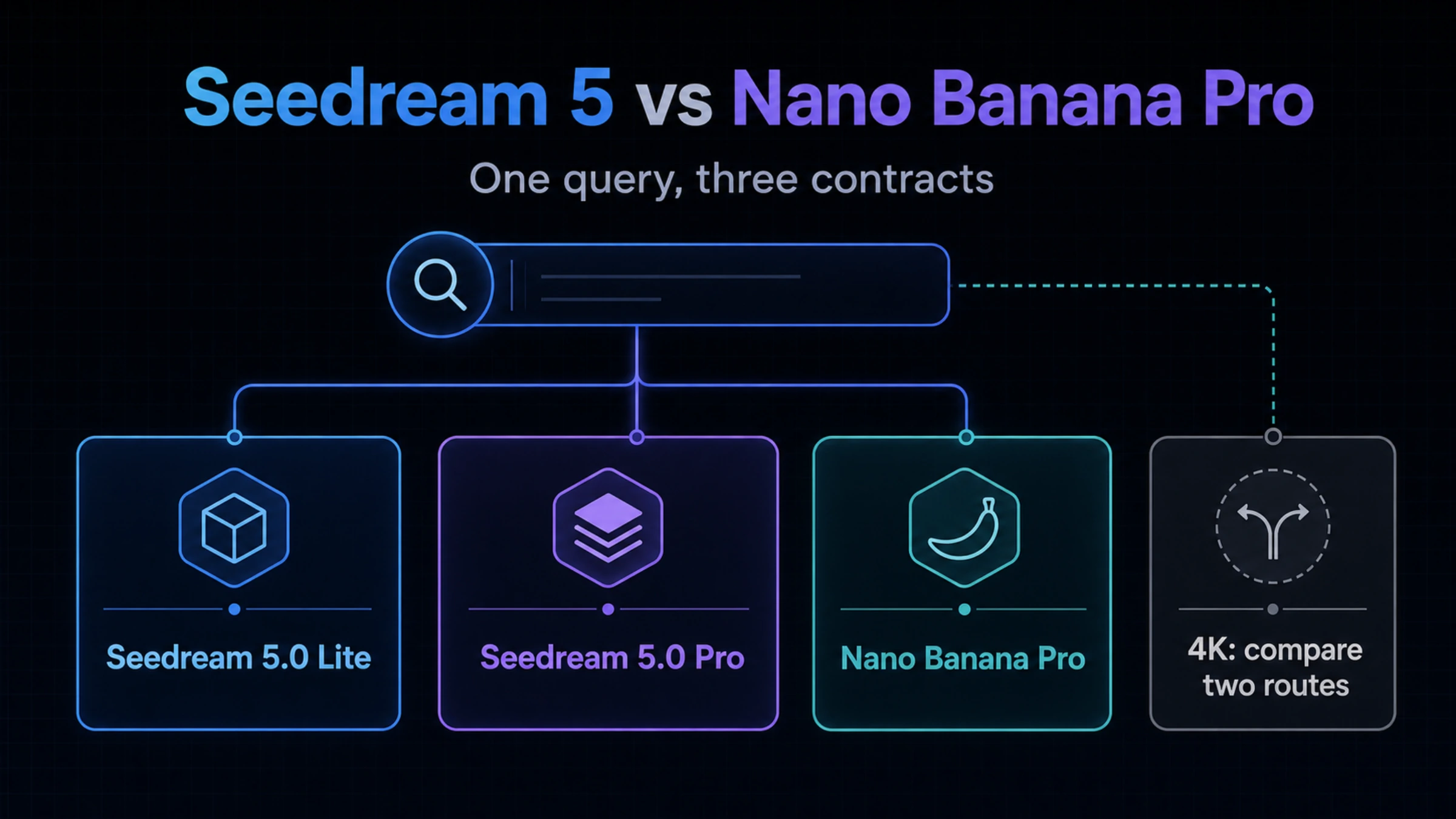
Choose by the failure that can sink the final asset—not by the broadest feature list.
- Start with Seedream 5.0 Lite when streaming, 2K-to-4K output, up to 14 references, or low-priced exploration is the hard production requirement.
- Include Seedream 5.0 Pro when its separate 1K, 1.5K, or 2K contract and direct BytePlus price shape fit the handoff; it is not Lite with every limit increased.
- Start with Nano Banana Pro when Search grounding, up to three style references, Google's professional-asset focus, or 1K, 2K, or 4K Gemini output addresses the actual risk.
- If 4K is the only non-negotiable requirement, keep Lite and Nano Banana Pro on the shortlist. Seedream 5.0 Pro currently tops out at 2K.
This is not a two-model contest. “Seedream 5” can mean Lite or Pro, and switching the tier changes the output, streaming, reference, and price boundaries. Nor is ordinary image generation or editing a unique reason to choose Nano Banana Pro: several routes can generate, edit, and use references. The useful question is which documented difference removes a real delivery failure.
Lock the exact contract before trusting a comparison
The current BytePlus generation guide and Google's Gemini image-generation guide identify three distinct API contracts.
| Model | Current documented ID | Boundaries that can change the decision |
|---|---|---|
| Seedream 5.0 Lite | seedream-5-0-260128, also seedream-5-0-lite-260128 | 2K, 3K, 4K; streaming; up to 14 reference images |
| Seedream 5.0 Pro | dola-seedream-5-0-pro-260628 | 1K, 1.5K, 2K; no streaming; up to 10 reference images |
| Nano Banana Pro | gemini-3-pro-image | 1K, 2K, 4K; Search grounding, thinking, multi-turn generation and editing; up to 6 high-fidelity objects, 5 characters, and 3 style references |
The maxima are interface categories, not acceptance guarantees. Fourteen references do not prove that fourteen identities will remain stable. Three style references do not guarantee brand compliance. A supported output size says nothing about whether text, product geometry, or an untouched region will pass approval.
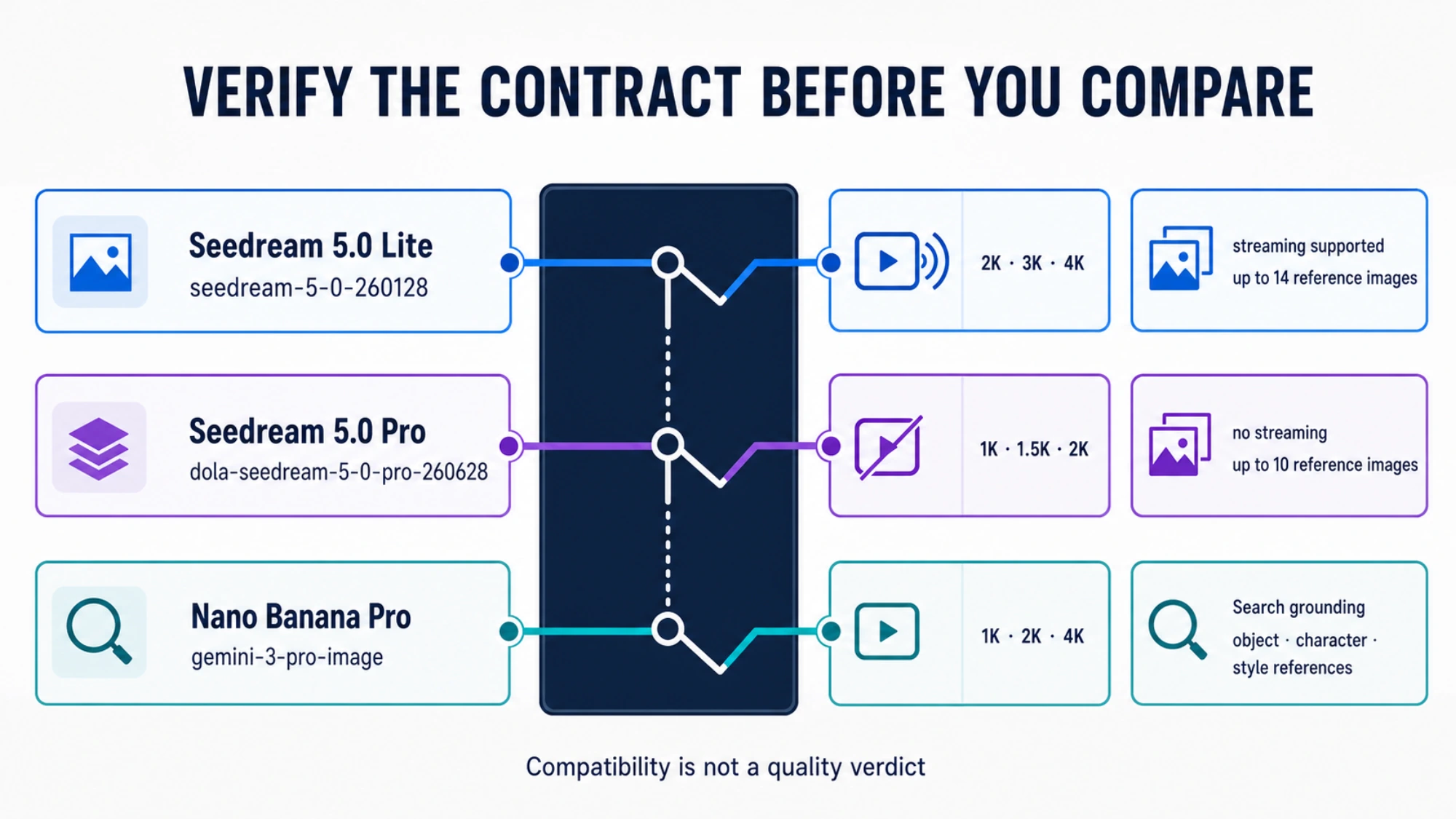
If a service exposes only “Seedream 5,” inspect the actual request, maximum size, streaming behavior, and reference allowance. If those fields are hidden, the service may still be convenient, but its price and results cannot be generalized to both BytePlus contracts.
The same rule applies to Google. Nano Banana Pro is gemini-3-pro-image, not Nano Banana 2 (gemini-3.1-flash-image). A speed or price claim for one model does not transfer to the other.
Use differences that can eliminate a route
Streaming or a reference-heavy candidate pool points to Lite
Seedream 5.0 Lite supports streaming, 2K, 3K, and 4K output, and up to 14 reference images. That contract fits concept batches, related campaign candidates, or a job that needs a broader reference set before final selection.
It does not prove continuity across a sequence. If the deliverable depends on identity, clothing, product shape, palette, or camera logic across several frames, grade those properties on every accepted image rather than treating batch generation as batch consistency.
Seedream 5.0 Pro must earn a place on contract fit
Seedream 5.0 Pro is a separate route with 1K, 1.5K, and 2K output, no streaming, and up to 10 references. BytePlus prices Pro output at $0.045 at or below 2.61 million pixels, described as 1.5K or lower, and $0.090 above that boundary. BytePlus also says 1.5K costs the same as 1K and presents 1.5K as the better-quality option within Pro.
That price and size shape can justify including Pro when it fits the delivery spec, but BytePlus's positioning is not a matched comparison with Lite or Nano Banana Pro. Confirm the exact ID and output size exposed by the provider. “Pro” by itself does not prove better text, identity, editing, or lower repair time.
Search grounding or Gemini style references point to Nano Banana Pro
Nano Banana Pro is the route here whose current Google documentation lists Search grounding and a separate allowance of up to three style references. Google also positions it for complex professional assets, localization, brand consistency, and precision control.
Those facts justify a first test when outside information or style references are integral to the job. They do not establish factual accuracy or brand compliance. Verify dates, prices, map labels, citations, text, colors, and protected geometry against the approved source before delivery.
A 4K requirement does not choose the winner
Seedream 5.0 Lite and Nano Banana Pro both document 4K output. Seedream 5.0 Pro documents 1K, 1.5K, and 2K. That can eliminate Pro from a 4K-only pipeline, but it cannot choose between Lite and Nano Banana Pro. Test the typography, identity, reference use, and edit behavior the client will approve.
Do not pay twice for a shared capability
Generation, editing, high-resolution output, and reference inputs appear across more than one contract. A feature table becomes misleading when it turns the presence of a shared noun into a unique purchasing reason.
Use the boundary behind the feature instead:
- for references, compare category and maximum, then test identity or object retention;
- for editing, compare the actual control exposed by the provider, then require both the requested change and all protected regions to pass;
- for resolution, eliminate contracts below the required size, then judge the content inside the file;
- for grounding, verify which documented service supplies it and independently check every factual element.
This distinction also keeps vendor positioning in its proper place. BytePlus and Google can describe intended workloads; only a matched test on the buyer's assets can establish acceptance or repair cost.
Public routing guides are starting hypotheses
An EvoLink routing guide separates Seedream 5.0 Lite, Seedream 5.0 Pro, and Nano Banana Pro and assigns different request types to drafts, exact-size delivery, references, text, editing, and product work. That is more useful than declaring one permanent winner.
It remains provider-authored guidance, not a matched benchmark. Some of its technical labels differ from the current direct BytePlus or Google records, and it does not measure repeat variance, pass criteria, repair time, or accepted-output cost. Use first-party documents for the contract and a provider guide only to identify a risk worth testing.
Compare current price after capability narrows the field
As checked August 9, 2026, the direct API output prices are:
| Model and paid API mode | Published output price | Important additions |
|---|---|---|
| Seedream 5.0 Lite | $0.035 per successfully output image | provider markup, retries that output unusable files, and repair remain separate |
| Seedream 5.0 Pro | $0.045 at or below 2.61M pixels, described as 1.5K or lower; $0.090 above | first input image free; each input from the second costs $0.003 |
| Nano Banana Pro Standard | $0.134 at 1K or 2K; $0.240 at 4K | image input, text or thinking output, grounding, review, and repair can add cost |
Sources: BytePlus ModelArk pricing and Gemini Developer API pricing. These tables do not establish US tax, consumer entitlement, subscription value, or a third-party provider's final charge.
The lowest output price is not automatically the lowest cost per approved asset. Track all billed API spend through acceptance, then divide by accepted assets. Track repair minutes with the same denominator. If one dollar total is needed, convert labor with an agreed hourly rate before adding it to API cost.
Settle the unknowns with one representative deliverable
After hard requirements eliminate the wrong routes, choose the asset that concentrates the remaining risk: a text-heavy campaign image, a protected character edit, a reference-heavy product scene, or a sourced 4K diagram.
Record enough context to make the result reusable:
- exact model ID, provider, date, and paid mode;
- source files, target aspect ratio, output resolution, and reference categories;
- non-negotiable failures such as misspelled copy, identity drift, product deformation, missing elements, or insufficient size;
- total billed spend and human repair time through the first accepted output.
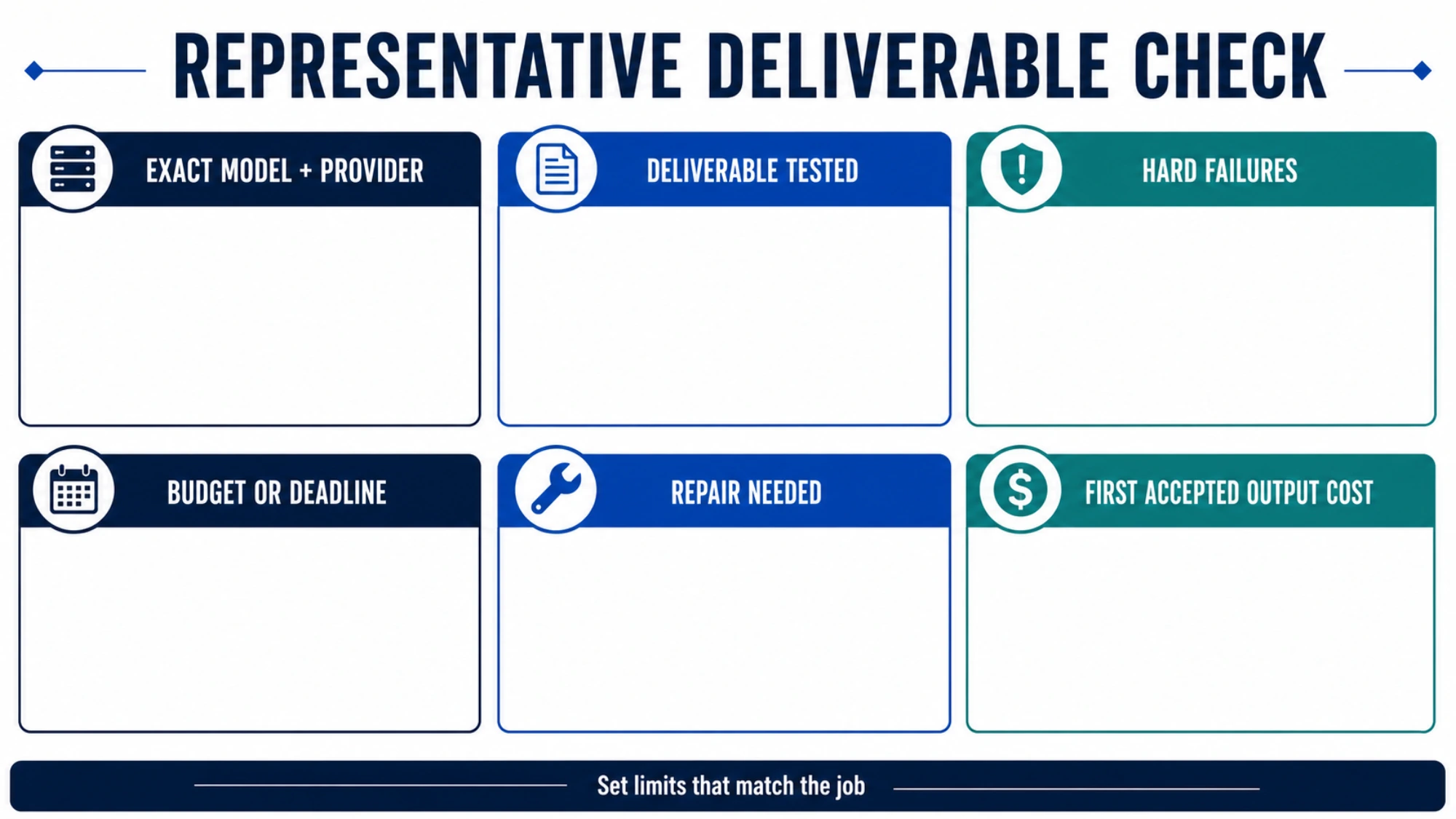
Give each route a comparable dollar or time allowance. A rigid attempt count is not required when the APIs expose different workflows. Reject hard failures before judging style, and compare surviving images without model labels when practical. This separates “the logo is wrong” from “I prefer this lighting.”
Which route should go first?
Start with Lite for streaming, reference-heavy exploration, or 2K-to-4K candidate production. Include Seedream Pro when its exact 1K, 1.5K, or 2K contract remains compatible and its price shape or representative trial justifies the route. Start with Nano Banana Pro when Search grounding, Gemini style references, or Google's professional-asset contract addresses the costly failure. For 4K alone, test Lite and Nano Pro on the actual approval criteria.
A staged path can be rational—Lite for breadth, Seedream Pro when a matched mid-resolution trial earns its place, or Nano Pro for a grounded or style-reference final—but only when the handoff saves more retries or repair than it adds. Lock the IDs first, test a real delivery risk, and let the accepted asset decide the route.