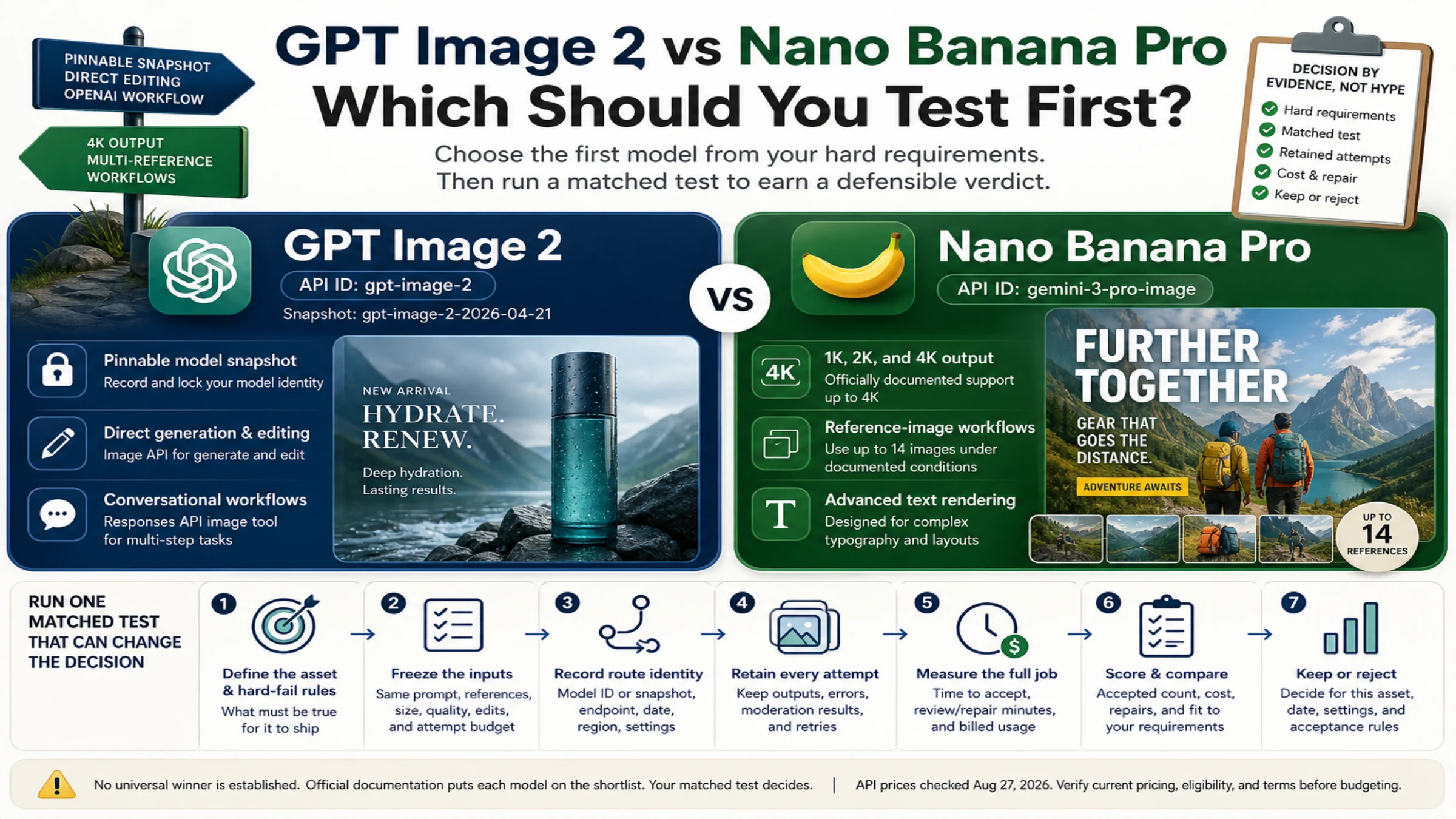
The short answer: test Nano Banana Pro first when 4K output or a documented, reference-heavy workflow is a hard requirement. Test GPT Image 2 first when a pinnable model snapshot, a direct generation-and-editing API, or a conversational image tool in an OpenAI workflow matters most.
That recommendation only chooses a starting point. It does not name a universal quality, speed, text-rendering, consistency, pass-rate, or value winner. No current, independently reproduced output set in the reviewed evidence holds the exact models, prompts, references, settings, attempt budget, region, and acceptance rules constant.
The useful decision is therefore: which exact model should enter your first test, and what evidence would let you keep or reject it?
First, compare the models you actually named
Nano Banana Pro and Nano Banana 2 are different Google models. Comparisons that silently swap one for the other do not answer the same question.
| Product name | Current API model ID | What it means for this comparison |
|---|---|---|
| Nano Banana Pro | gemini-3-pro-image | This is Gemini 3 Pro Image and the Google model compared in this article |
| Nano Banana 2 | gemini-3.1-flash-image | This is Gemini 3.1 Flash Image; its results cannot establish Nano Banana Pro performance, price, or access |
| GPT Image 2 | gpt-image-2 | This is OpenAI's current GPT Image API model; OpenAI also lists the fixed snapshot gpt-image-2-2026-04-21 |
Google's image-generation documentation distinguishes the two Nano Banana generations. OpenAI's GPT Image 2 model page documents the current model ID and the fixed snapshot.
This identity check matters beyond naming. A Nano Banana 2 gallery, latency report, price, or prompt test is not evidence about Nano Banana Pro. Likewise, an image made in a consumer app should not automatically be attributed to a public API model or fixed snapshot unless the interface exposes that identity.
Choose the first test from a disqualifying requirement
Start with the requirement that would make an otherwise attractive output unusable.
| Your hard requirement | Test first | What official documentation establishes | What remains for your test |
|---|---|---|---|
| 4K output | Nano Banana Pro | Google documents 1K, 2K, and 4K output for gemini-3-pro-image | Whether your required details, text, and composition survive at the target size |
| A reference-heavy composition | Nano Banana Pro | Google documents reference-image workflows reaching up to 14 images under specified conditions | Reference fidelity, identity preservation, and repair effort for your inputs |
| A pinnable API version | GPT Image 2 | OpenAI lists gpt-image-2-2026-04-21 | Whether the snapshot meets your asset's acceptance rules |
| Direct generation plus editing | GPT Image 2 | OpenAI documents generation and editing through the Image API | Edit compliance, preservation, failures, and total cost in your workflow |
| Conversational or multi-step image work | GPT Image 2 | OpenAI documents image generation and editing through the Responses API image tool | Orchestration reliability and the added usage of the main model |
| Interactive consumer use | Whichever product your account can access | Public product pages describe image experiences at a product level | Current plan, quota, region, fallback behavior, effective model, and data terms |
If neither model has a disqualifying advantage, keep both in the test. A feature table can narrow the field, but it cannot tell you which model will produce more acceptable assets from your prompts.
What each model documents—and does not prove
Nano Banana Pro: 4K and multi-reference options
Nano Banana Pro is Google's Gemini 3 Pro Image. Google's model documentation describes text and image input, text and image output, image generation, thinking, and Google Search grounding. Its image guide documents multi-turn generation and editing, 1K, 2K, and 4K output, advanced text rendering, and reference-image workflows that can reach 14 images under the documented input conditions.
Those are meaningful shortlist criteria, especially for a deliverable that requires 4K output or many references. They are not pass-rate evidence. Google's own Nano Banana Pro model page warns about possible failures involving small faces, spelling, fine details, factual accuracy, localization, complex edits, blending, and character consistency. Curated provider examples do not quantify those failures for your work.
GPT Image 2: pinned, direct, and conversational paths
GPT Image 2 accepts text and image input and produces image output. OpenAI documents generation and editing, including single-call work through the Image API and conversational or multi-step work through the Responses API image tool. The guide exposes size and quality controls, while the fixed gpt-image-2-2026-04-21 snapshot gives API teams a model identity they can record and pin.
That makes GPT Image 2 a sensible first candidate when reproducible API identity or an existing OpenAI agent workflow is a hard constraint. It still needs a task-specific acceptance test. OpenAI's image-generation guide notes that exact text placement, recurring-character or brand consistency, and spatially precise composition can remain difficult. These are provider-stated limitations, not evidence that Nano Banana Pro performs better.
Compare API cost on the same accounting surface
The following standard USD API prices were checked on August 27, 2026. They are not consumer subscription prices, and the output estimates are not automatically quality-matched.
| Model | Published API units | Reference image-output amount | Costs not captured by that amount |
|---|---|---|---|
Nano Banana Pro (gemini-3-pro-image) | $2 per 1M text/image input tokens; $12 per 1M text/thinking output tokens; $120 per 1M image output tokens | About $0.134 for 1K or 2K; $0.24 for 4K | Input images, text or thinking output, grounding beyond allowances, retries, taxes, and review or repair |
GPT Image 2 (gpt-image-2) | $8 per 1M image input tokens; $2 cached image input; $30 image output; $5 text input; $1.25 cached text input | About $0.006 low, $0.053 medium, or $0.211 high at 1024×1024 | Text and image input, size, quality, partial images, retries, Responses main-model use, taxes, and review or repair |
Sources: Gemini API pricing and OpenAI image pricing.
Do not conclude that one model is cheaper by lining up the smallest visible numbers. The quality tiers, dimensions, token rules, reference inputs, and workflow costs differ. A useful internal metric is:
“Accepted-asset cost = (generation + edit + retry charges + review and repair time) / accepted deliverables
You can calculate that only after a matched test. Also verify current official pricing, account eligibility, region, and billing immediately before budgeting; these details can change.
Run one matched test that can change the decision
A small production-like test is more useful than a broad prompt tournament. Choose one asset you genuinely need: a product banner with exact copy, a recurring-character panel, a localized campaign graphic, or an edit that must preserve protected details.
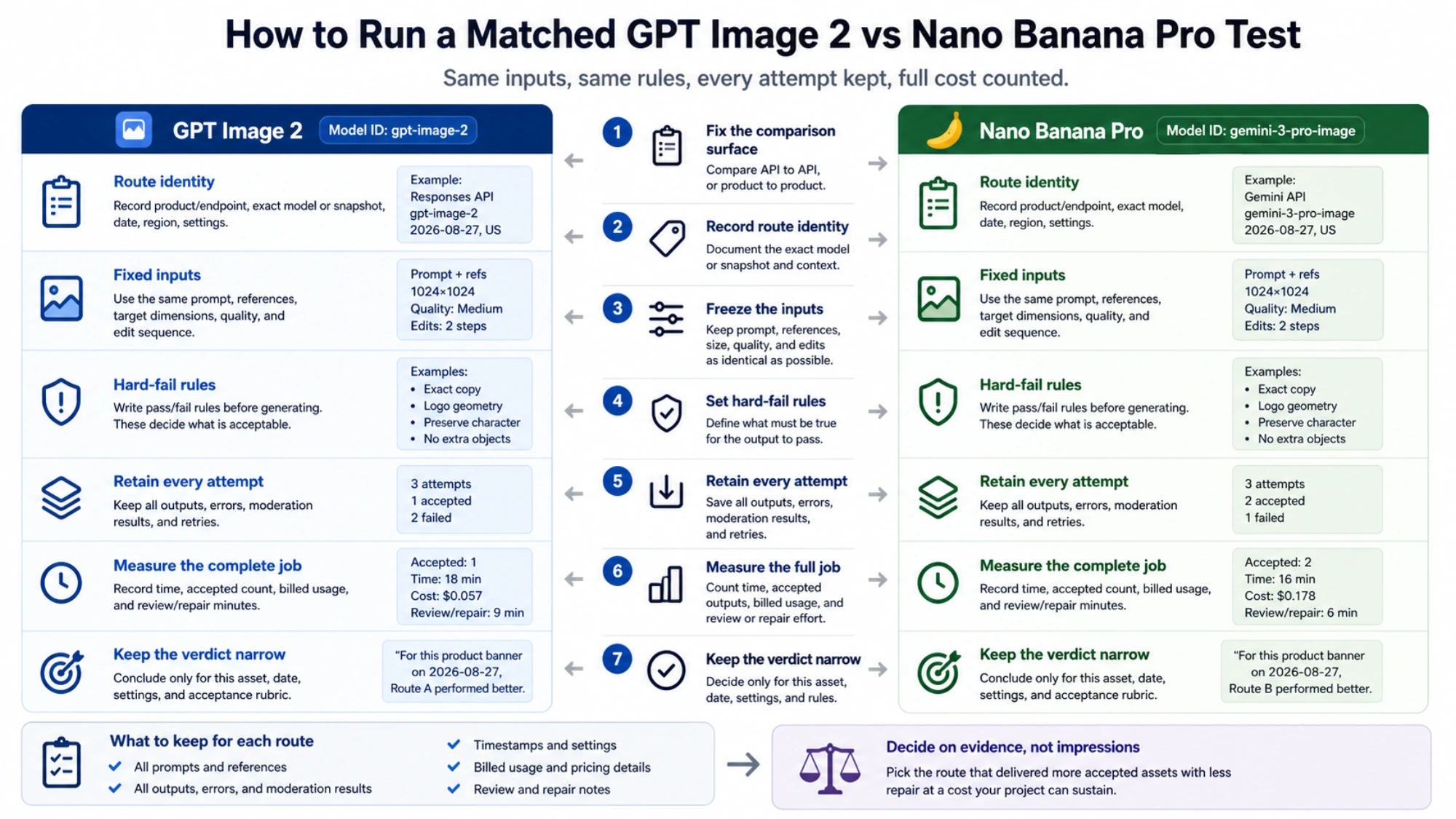
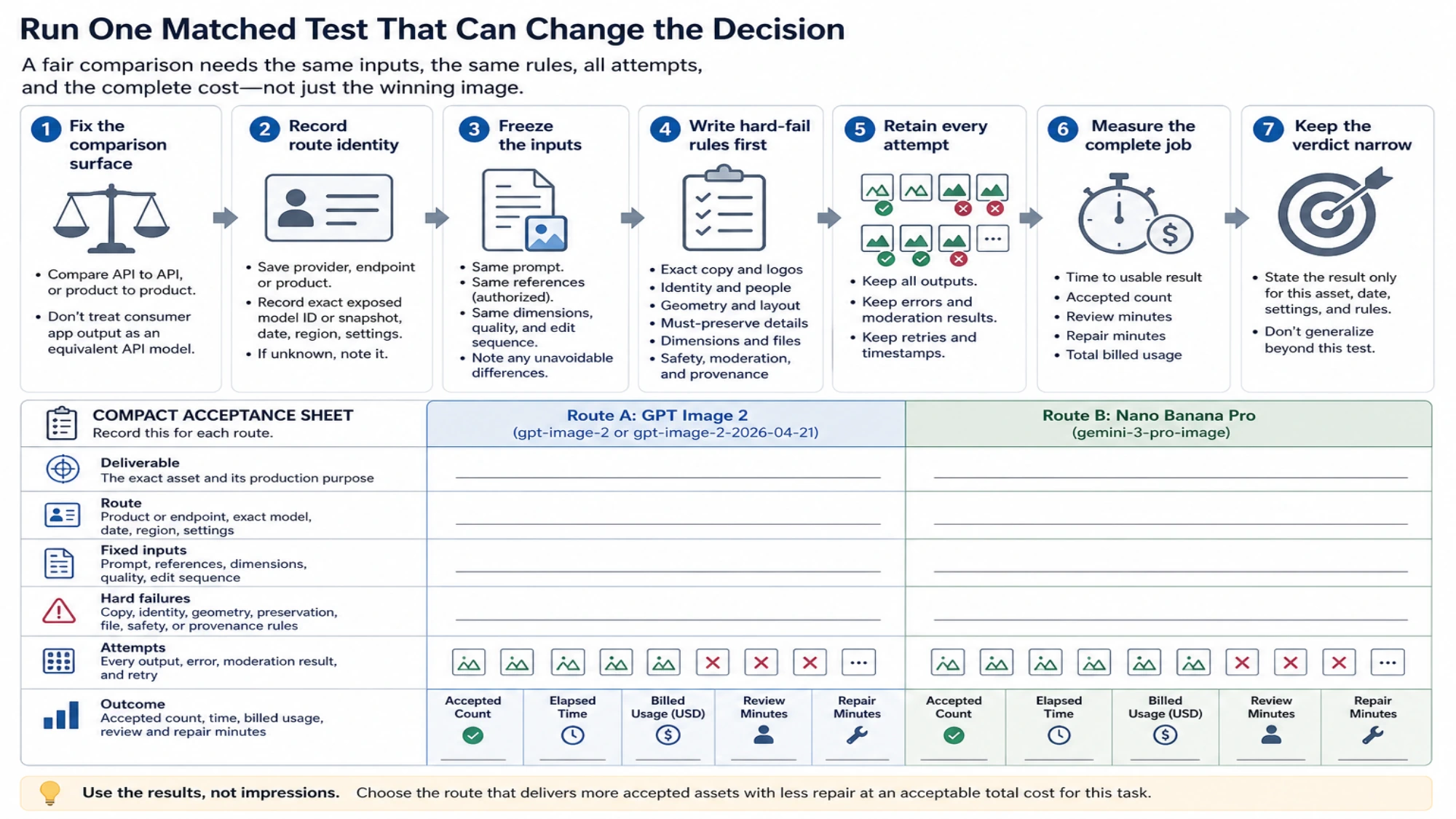
- Fix the comparison surface. Compare direct API with direct API, or consumer product with consumer product. Do not treat a consumer-app output as equivalent to a fixed API model.
- Record route identity. Save the provider, endpoint or product, exact exposed model ID or snapshot, date, account region, and settings. If the consumer interface does not expose the backend model, record it as unknown.
- Freeze the inputs. Use the same prompt, authorized references, target dimensions, edit sequence, and attempt budget wherever the interfaces allow it. Note unavoidable differences instead of hiding them.
- Write hard-fail rules before generating. Examples include exact copy, logo geometry, required people or products, prohibited changes, dimensions, file constraints, and provenance requirements.
- Retain every attempt. Keep accepted and rejected outputs, errors, moderation results, retries, billed usage, and timestamps. A selected favorite hides first-pass acceptance and failure cost.
- Measure the complete job. Record time to a usable result, accepted count, review minutes, repair minutes, and total billed usage—not just provider-reported generation speed.
- Keep the verdict narrow. Name the better route only for this asset, date, settings, and acceptance rubric.
A compact acceptance sheet
Use a record like this for each route:
| Field | Record |
|---|---|
| Deliverable | The exact asset and its production purpose |
| Route | Product or endpoint, exact exposed model, date, region, settings |
| Fixed inputs | Prompt, references, dimensions, quality, edit sequence |
| Hard failures | Copy, identity, geometry, preservation, file, safety, or provenance rules |
| Attempts | Every output, error, moderation result, and retry |
| Outcome | Accepted count, elapsed time, billed usage, review and repair minutes |
A defensible result sounds like: “For our 2K product-banner task, route A produced more accepted files with less repair under these settings.” It does not become “route A is the best image model” without broader matched evidence.
What not to infer from third-party comparisons
Hands-on comparisons can suggest prompts and failure modes worth testing. One commercial comparison published by ChatCut reports using identical wording across three prompt categories, three runs per model, and six scored dimensions, with task-dependent tradeoffs rather than complete dominance.
But its complete raw outputs, seeds, settings, timestamps, latency logs, evaluator records, and independent reproduction were not available. That makes it a reported claim, not a benchmark you can use to declare a universal winner. The same caution applies whenever a comparison mixes Nano Banana Pro with Nano Banana 2 or tests different consumer and API routes.
The practical verdict
Choose Nano Banana Pro first when 4K output or its documented reference-input range is a gate your deliverable must clear. Choose GPT Image 2 first when a pinnable snapshot, the Image API's generation-and-editing path, or a Responses-based image workflow fits your system.
For consumer products, begin with what your account and region actually expose. Current subscription prices, quotas, fallback behavior, effective model routing, and exact eligibility were not established consistently enough here to recommend a plan. API list prices should not be projected onto ChatGPT or Gemini consumer access.
If both models clear your hard requirements, test both on one real asset. Official documentation decides who belongs on the shortlist; retained outputs, failures, billed usage, and repair effort decide which route earns the next production job.